
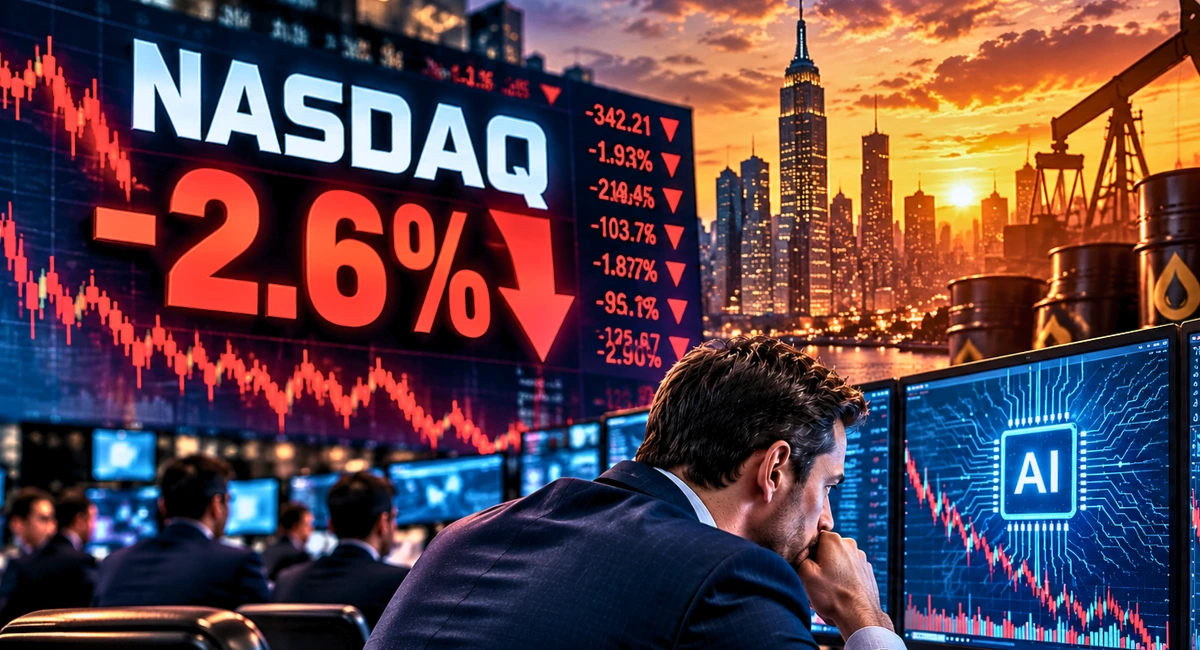
Tech stocks took a heavy beating on Thursday, October 22, 2026. The Nasdaq Composite posted its steepest one -day drop since June, as investors questioned how long companies can keep pouring money into artificial intelligence without showing clear profits. Rising oil prices added to nervousness, and by the close, the broader market had lost much of its earlier confidence.
Key Takeaway
- The Nasdaq Composite fell 2.60% to 26,007.86 on October 22, its worst daily performance since June.
- The S&P 500 slipped 1.21%, while the Dow Jones Industrial Average was almost flat.
- Investors are growing wary of heavy AI spending, even when companies beat revenue expectations.
- Semiconductor stocks, including Nvidia, were among the hardest hit.
- Brent crude climbed to roughly $113 per barrel amid tensions involving Iran.
- The Federal Reserve’s October 27–28 meeting is the next major event to watch.
What happened on October 22
The sell-off was driven mainly by technology shares. Investors moved out of growth stocks and into safer assets as uncertainty built up. Although many large companies have been reporting solid numbers, the market’s reaction showed that strong sales alone are no longer enough to calm nerves. Traders want to see how those sales turn into real cash and sustainable earnings.
Why AI Spending Is Spooking Investors
Artificial Intelligence has become the biggest spending story in tech. Companies are building data centres, buying advanced chips, and expanding computing infrastructure at a rapid pace. That spending has supported the industry for months, but it is now being questioned more closely.
Meta’s platform became a focal point during the session. The company reported revenue that beat expectations, yet its heavy AI – related spending, negative free cash flow, and plans for a new class of non-voting shares worried investors. The episode shows that rising costs and financing needs can outweigh Good top-line numbers.
For tech companies, the challenge is clear: prove that today’s infrastructure investments will pay off in future earnings and stronger cash generation.
Semiconductor stocks take a Hit.
Chipmakers sit at the centre of the AI boom. Companies that design chips, manufacture them, or supply advanced computing equipment depend on steady demand from the big spenders. When investors start doubting future spending, these firms often feel the pressure first, because their share prices usually reflect expectations of strong growth.
Nvidia and several other semiconductor names fell during the session, and the Philadelphia Semiconductor Index dropped significantly.
This does not necessarily mean AI demand is disappearing; more likely, investors are asking how much future growth is already priced into these stocks. A great technology does not automatically make every company connected to it a good investment at any price.
Oil prices add to Market Anxiety.
Energy was the second major source of worry. Brent crude rose to about $ 113 per barrel as tensions involving Iran raised concerns about supply. Higher oil prices push up transportation, manufacturing, and fuel costs, which can squeeze both businesses and households.
If oil stays elevated, inflation could prove harder to bring down. That would complicate the Federal Reserve’s interest-rate decisions. Keeping borrowing costs high for longer tends to hurt companies whose valuations depend on profits far in the future, which is one reason growth stocks are sensitive to energy shocks.
A single day of higher oil Prices does not confirm a lasting inflation trend, though. How long the energy shock lasts will matter a great deal.
How the Major US Indexes Performed
| Index | Closing Level |
|---|---|
| Nasdaq Composite | 26,008.86 |
| S&P 500 | 7,663.43 |
| Dow Jones Industrial Average | 52,867.9 |
Nasdaq’s bigger drop reflects its heavy weighting in technology and growth companies. The Dow’s near-flat results show that the pain was concentrated rather than spread evenly. Interestingly, the Associated Press reported that most US stocks actually rose, which suggests that a handful of large tech names did most of the damage to the headline indexes.
Why the Dow Held Up
The Dow contains a different mix of companies than the Nasdaq, with fewer pure technology names and more exposure to industrial, financial, and consumer businesses. That mix helped it avoid the worst of the AI-driven selling. It is a reminder that index-level numbers can hide very different experiences across sectors.
What This Means For Investors
Short- term volatility could continue. Markets are likely to stay sensitive to earnings reports, AI Investment announcements, oil prices, and interest-rate expectations. A sharp drop does not automatically mean a stock is cheap, and it does not mean a quick recovery.
Investors should separate temporary price swings from real changes in a company’s long-term outlook. Cash flow deserves close Attention. Revenue growth matters, but so do operating expenses, capital spending, free cash flow, and management guidance. Companies that can fund their investments while keeping financial flexibility are generally better placed to ride out uncertain periods.