
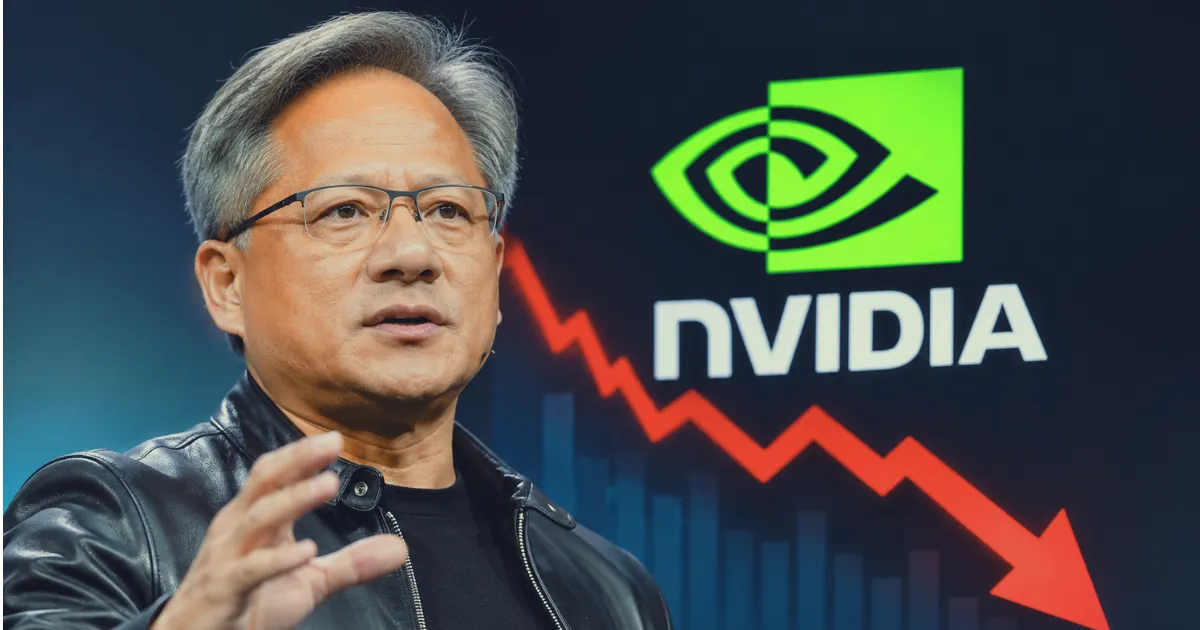
For much of the artificial intelligence boom, Nvidia was the company investors could hardly ignore. Its graphics processing units (GPUs) became essential components of the infrastructure powering generative AI, large language models and modern data centres. As demand for artificial intelligence expanded, Nvidia’s revenue and market value climbed dramatically, turning the semiconductor company into one of the most valuable businesses in the world.
But the market mood has changed.
On November 20, 2026, Nvidia shares closed at $125.53, down 14.01% in a single trading session. The fall extended the company’s losing streak to seven consecutive weeks, its longest such run since the 2008 financial crisis. The stock also recorded a weekly decline of approximately 23%.
The sell-off has been particularly striking because it came shortly after Nvidia reported another quarter of exceptional financial growth. The company is still generating enormous revenue from AI infrastructure, but investors are increasingly concerned about its leadership transition, regulatory scrutiny and the sustainability of the wider AI investment cycle.
Nvidia’s market value also fell below that of Alphabet, making it the fourth-most valuable publicly traded US company at the time.
For investors following global markets, including those in India, this is more than a story about one technology stock. Nvidia sits at the centre of a global supply chain connecting semiconductor manufacturers, cloud providers, technology companies and data centre operators. When confidence in Nvidia weakens, the impact can extend well beyond its own shares.
So what is happening at Nvidia, why are investors worried despite strong earnings, and what should everyday investors understand before reacting to the headlines?
Key Takeaways
- Historic losing streak: Nvidia recorded seven consecutive weekly declines, its longest such run since 2008.
- Sharp Friday fall: Shares dropped 14.01% to $125.53 on November 20, while the weekly decline reached approximately 23%.
- Leadership transition: Jensen Huang resigned as CEO, and CFO Colette Kress became interim CEO.
- Regulatory pressure: California authorities issued an investigative subpoena, while the SEC separately examined potential accounting issues.
- Strong financial performance: Nvidia reported $115.8 billion in quarterly revenue, up 103% year over year.
- Market ranking changed: Nvidia’s market capitalisation fell below Alphabet’s, placing it fourth among the most valuable US companies.
- Wider technology weakness: The sell-off spread across semiconductor stocks and major US market indexes.
- Investor lesson: Strong earnings do not eliminate valuation, leadership, regulatory or market risks.
1. What Happened to Nvidia Shares?
Nvidia’s decline became particularly severe during the week ending November 20.
The stock closed Friday at $125.53, compared with $145.98 in the previous session. That represented a loss of $20.45 per share in one day.
However, the bigger picture is even more significant.
The November 20 decline was part of a seven-week losing streak. Nvidia’s shares had been falling for seven consecutive weeks, recording their longest weekly losing run since the global financial crisis in 2008.
According to market coverage, the stock had fallen approximately 48% from its October 6 record high. The decline erased a substantial amount of its market value and pushed its valuation below Alphabet.
It is important to distinguish between two figures here. The 14% decline refers to Friday’s single trading session, while approximately 23% represents the loss over that particular week. The roughly 48% decline measures the fall from the October record high.
Why does this distinction matter?
Because a stock can experience a particularly damaging trading session within a much longer period of weakness. Looking at only one day’s movement does not explain the full scale of the decline.
Nvidia’s sell-off also occurred during a difficult week for technology stocks generally. Investors were reducing exposure to companies whose valuations had benefited significantly from expectations of continued AI spending.
In other words, Nvidia was facing company-specific concerns at the same time that the broader market was becoming less comfortable with expensive technology stocks.
2. Jensen Huang’s Departure Creates Leadership Uncertainty
One of the biggest developments affecting Nvidia was the resignation of co-founder and longtime CEO Jensen Huang.
On November 11, Nvidia’s board accepted Huang’s resignation as president, chief executive officer and board member, effective immediately. The company appointed Colette Kress, its long-serving chief financial officer, as interim CEO while the board searches for a permanent replacement.
For investors, this was a major development.
Huang had led Nvidia through several important stages of its growth, from its early focus on graphics processing to its position as a leading supplier of AI computing infrastructure. His leadership was closely associated with the company’s product strategy, business relationships and long-term vision.
When a founder who has led a company for decades suddenly leaves, investors naturally begin asking questions about what comes next.
Will the new leadership maintain the same strategic direction? Will important customers and business partners remain confident? Can the company continue executing its ambitious product roadmap without the person most closely associated with its transformation?
These questions become especially important when a company’s valuation reflects high expectations about future growth.
The circumstances surrounding Huang’s departure also attracted attention. News reports described revelations about his personal relationships, including allegations involving a businesswoman whose possible connections to Chinese intelligence were being examined by US authorities. These reports became part of a wider controversy surrounding Nvidia’s leadership and potential China-related risks.
It is essential to distinguish allegations and investigations from established wrongdoing. The existence of an investigation does not prove that Huang or Nvidia violated any law.
Nevertheless, the sudden leadership change has introduced uncertainty at a time when investors are already questioning the durability of the AI boom.
3. Regulatory Scrutiny Adds to Nvidia’s Problems
Leadership uncertainty is not the only issue facing the company. Nvidia is also dealing with scrutiny from US authorities on two separate fronts.
California investigates potential China-related risks.
On November 19, California Attorney General Rob Bonta announced an investigative subpoena directed at Nvidia.
The investigation concerns questions about whether advanced Nvidia chips or confidential information may have reached China, and whether the company or its former CEO misled investors or the public about related risks.
The investigation follows reports involving Huang’s former relationships and questions about possible connections to China.
The issue matters because the United States has imposed restrictions on exports of certain advanced semiconductor products to China. These controls are intended to limit access to technology that could strengthen China’s advanced computing and military capabilities.
Nvidia operates in a global semiconductor market, and China has historically been an important market for technology products. Export restrictions can therefore affect its commercial opportunities while also creating complicated compliance responsibilities.
However, an investigative subpoena is not a finding that Nvidia broke the law. It is a legal step used to obtain information as part of an investigation. The authorities will need to examine the evidence before reaching any conclusions.
SEC examines potential accounting issues
A separate development came on November 20, when Reuters reported that the US Securities and Exchange Commission was examining potential accounting issues at Nvidia.
The investigation adds another layer of uncertainty because accounting and financial disclosures are central to how investors evaluate a publicly traded company.
One area attracting attention concerns Nvidia’s reporting of geographic revenue. The company previously changed its reporting approach, using customer headquarters rather than billing addresses to determine geographic revenue. The change removed Singapore from its geographic revenue breakdown.
The reporting change attracted renewed attention after questions emerged about the scale of Nvidia-related business activity in Singapore and its possible connection to chip shipments ultimately destined for China.
Reuters also reported that investigators were examining potential accounting issues, although the precise scope and timing of the SEC inquiry had not been established.
There is an important distinction here: an investigation is not proof of accounting fraud or other wrongdoing. Regulators may investigate issues that do not ultimately result in enforcement action.
Still, the uncertainty can influence investor sentiment. When a company is already dealing with leadership disruption and questions about its international business, additional regulatory scrutiny can make shareholders more cautious.
4. Nvidia’s Financial Results Tell a Different Story
Perhaps the most interesting part of the current situation is that Nvidia’s business performance remains exceptionally strong.
On November 17, the company announced its results for the third quarter of fiscal 2027, covering the three months ended October 25.
The numbers were impressive.
| Financial measure | Q3 fiscal 2027 |
|---|---|
| Total revenue | $115.8 billion |
| Data Centre revenue | $107.6 billion |
| Year-over-year revenue growth | 103% |
| GAAP gross margin | 74.8% |
| GAAP operating income | $77.5 billion |
| GAAP net income | $65.3 billion |
| GAAP diluted EPS | $2.70 |
Total revenue increased 103% compared with the same quarter a year earlier. Data Centre revenue, which represents the company’s most important AI infrastructure business, reached $107.6 billion, increasing 110% year over year.
The company also reported GAAP net income of $65.3 billion.
These figures demonstrate that demand for Nvidia’s products remains substantial. Businesses are continuing to invest in computing infrastructure to train and operate AI models, and Nvidia remains a major supplier of the processors and systems supporting that expansion.
The company also guided for the fourth quarter of fiscal 2027, forecasting revenue of approximately $130 billion, with a possible variation of 3% in either direction.
So why did the stock fall despite such strong results?
Because financial markets do not price shares based only on what a company has already earned. They also price expectations about future performance.
Investors may believe Nvidia is an excellent business while simultaneously questioning whether its shares are worth their previous market price.
In Nvidia’s case, the market is considering several risks at once: leadership uncertainty, regulatory investigations, competition, the future pace of data centre investment and the possibility that AI-related spending could eventually slow.
Strong earnings can support a company’s long-term investment case, but they do not guarantee that its stock price will rise immediately.
5. Why Nvidia’s Market Position Has Changed
Nvidia’s decline also reshuffled the ranking of America’s most valuable companies.
According to LSEG data cited by Reuters, the approximate market capitalisations around the November 20 market move were:
| Company | Market capitalisation |
|---|---|
| Apple | $5.08 trillion |
| Microsoft | $3.72 trillion |
| Alphabet | $3.44 trillion |
| Nvidia | $3.03 trillion |
These figures reflect the market snapshot around the sell-off and can change with share prices.
Nvidia’s move into fourth place is more than a change in ranking. It reflects how investors are reassessing the risks associated with different technology businesses.
Apple has a large consumer hardware and services ecosystem. Microsoft combines enterprise software, cloud computing and AI products. Alphabet has advertising, search, cloud computing and its own AI development activities.
These companies are also exposed to the AI investment cycle, but their revenue comes from several established business areas.
Nvidia, by comparison, is more directly connected to demand for advanced computing hardware. Its business is benefiting enormously from the AI infrastructure boom, but its growth expectations are also sensitive to changes in data centre investment.
That does not make Nvidia a weaker business. It means investors may be evaluating its exposure to the AI spending cycle differently from the broader revenue mix of its largest competitors.
6. The Sell-Off Spreads Across Technology and Global Markets
Nvidia’s decline did not happen in isolation.
On November 20, technology stocks experienced a broad sell-off, with semiconductor companies among the hardest hit.
Reuters reported that:
- The Nasdaq Composite fell 5.3% on Friday and lost approximately 10% over the week.
- The S&P 500 declined 3.7% during the session.
- Nvidia fell 14%.
- Anthropic shares declined approximately 9%.
- The semiconductor index lost around 11%.
- The VIX volatility index, often used as a measure of expected market volatility, rose sharply.
The decline pushed the Nasdaq into correction territory, generally defined as a fall of at least 10% from a recent peak.
Other semiconductor companies also suffered substantial losses. AMD, Micron and Broadcom were among the technology stocks under pressure.
The weakness was particularly notable because it followed Anthropic’s highly publicised stock market debut. Instead of strengthening confidence in the AI sector, the trading session highlighted how quickly investors could shift from enthusiasm to caution.
Several concerns contributed to the broader sell-off.
First, investors are questioning whether the enormous amounts being spent on AI infrastructure will generate sufficient returns. Data centres require expensive chips, electricity, networking equipment and buildings. Companies investing in this infrastructure need to demonstrate that the spending can eventually produce meaningful profits.
Second, high valuations leave less room for disappointment. When investors expect exceptional growth, even a strong earnings report may not be enough if future expectations become less certain.
Third, rising interest-rate expectations can make expensive growth stocks less attractive. Higher borrowing costs increase the cost of financing new infrastructure and can reduce the present value investors place on future earnings.
The result was a broader reduction in risk exposure rather than a reaction to Nvidia alone.
7. What Nvidia’s Decline Means for Investors in India
For Indian investors, a sharp fall in a major US technology company can create concern, particularly among those holding international funds, US stocks or technology-related investments.
However, it is important to remember that Indian markets have their own economic and corporate drivers. A decline in Nvidia does not automatically mean that Indian stock markets must follow the same direction.
There are three areas worth watching.
Foreign investment flows
International investors often adjust their portfolios when volatility rises in major markets. If global funds reduce exposure to technology stocks or emerging markets, Indian equities can experience additional selling pressure.
However, foreign investment flows are influenced by several factors, including currency movements, interest rates, domestic economic growth and corporate earnings. Nvidia’s share price is only one part of the picture.
Indian IT and technology companies
Nvidia’s performance can influence sentiment towards the broader technology sector, but its business model is different from that of many Indian IT services companies.
Nvidia primarily supplies semiconductor technology and computing platforms. Indian IT companies generally provide software development, consulting, cloud migration and business technology services.
A change in global AI investment priorities may affect demand for technology services, but the impact will differ from company to company.
Indian businesses that successfully help clients implement AI could find new opportunities. At the same time, companies that depend heavily on traditional services may face pressure to adapt their offerings.
International funds and direct US investments
Investors who hold US technology stocks or international mutual funds and exchange-traded funds may have direct exposure to Nvidia or other companies affected by the sell-off.
It is worth checking how much of a portfolio is concentrated in a small group of large technology businesses. Diversification can help reduce dependence on any single company, industry or market trend.
8. What Should Investors Learn From Nvidia’s Decline?
Nvidia’s recent performance offers several useful lessons, particularly for investors who became interested in technology stocks during the AI boom.
A strong business is not automatically a good investment at every price. Nvidia’s earnings remain impressive, but investors still need to consider valuation. The price paid for a stock matters because even excellent companies can deliver disappointing returns when expectations become too high.
Leadership matters. A sudden departure by a founder or long-serving CEO can introduce uncertainty, especially when the person has played a central role in the company’s strategy and relationships.
Regulatory risk should not be ignored. Companies operating in sensitive industries such as advanced semiconductors face changing export rules, national security concerns and complex international regulations. Investigations do not prove wrongdoing, but they can create uncertainty.
A losing streak does not identify the bottom. A stock that has fallen for seven consecutive weeks may appear cheaper than it was before. But that does not mean it cannot fall further. Investors should avoid making decisions simply because a share price has declined sharply.
Diversification remains important. Concentrating a large portion of savings in one company or a single popular sector can expose a portfolio to significant losses when market sentiment changes.
For long-term investors, the focus should remain on business fundamentals, financial strength, valuation and personal investment goals rather than trying to predict the next daily market movement.
The Bottom Line
Nvidia’s seven-week decline is a reminder that even the most successful companies can face a difficult period when business uncertainty and investor expectations collide.
The company’s latest financial results show that demand for AI computing remains strong. Revenue is growing rapidly, its Data Centre business continues to expand, and management has provided an optimistic near-term revenue outlook.
But strong financial performance does not make a company immune to leadership changes, regulatory investigations or changing market expectations.
The bigger question for investors is whether the enormous investment in artificial intelligence will continue at its current pace and whether the companies supplying the technology can sustain their growth.
For investors in India and elsewhere, Nvidia’s decline should be a reason to review risk exposure, not a reason to panic. Avoid concentrating savings in a single popular stock, understand the risks behind international investments and make decisions based on financial goals rather than market excitement.
The AI industry may continue to grow for years. But the stock market will keep reassessing which companies can turn that growth into lasting profits.
Disclaimer: This article is intended for general informational and educational purposes only and should not be considered financial or investment advice. Stock prices, market valuations and company financial results can change rapidly. Regulatory investigations discussed in this article do not establish wrongdoing, and readers should distinguish allegations from confirmed findings. Investors should conduct their own research and consult a qualified financial adviser, including a SEBI-registered investment adviser where appropriate in India, before making investment decisions. HenceMyMoney does not guarantee investment returns and is not responsible for financial losses resulting from decisions made based on this article.