
For much of the year, the American housing market has felt like a market waiting for the right moment. Potential homebuyers have been watching mortgage rates and property prices, hoping borrowing costs would become more manageable. Meanwhile, many existing homeowners have been reluctant to sell because they are still benefiting from the unusually low mortgage rates secured during the pandemic.
Now, there is a small reason for optimism.
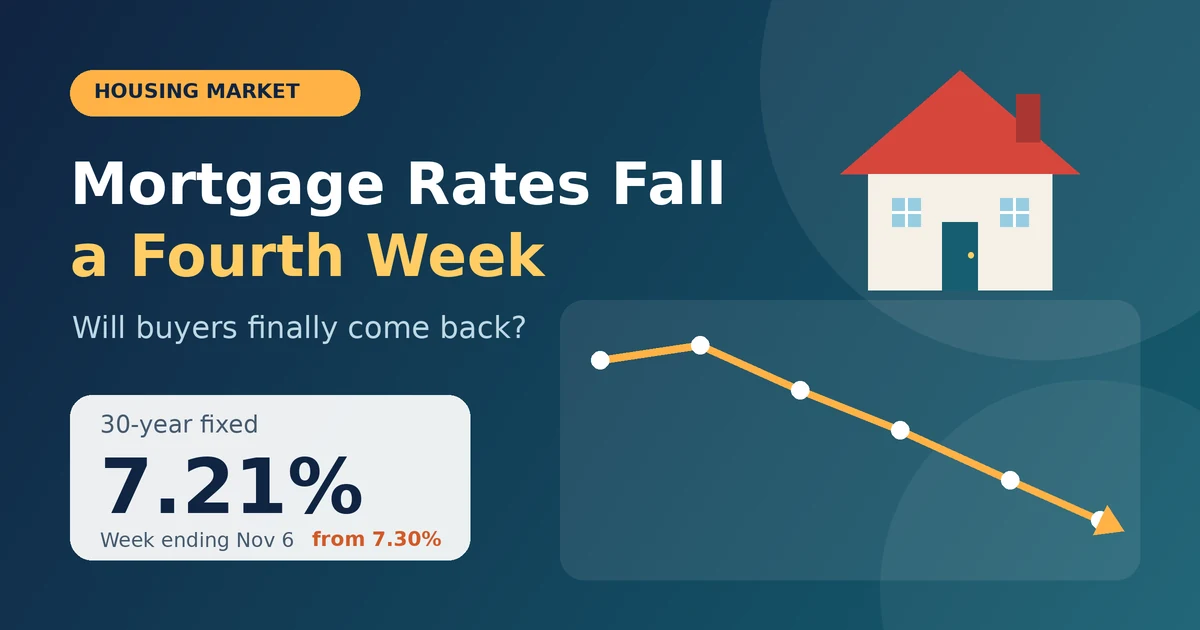
U.S. mortgage rates declined for the fourth consecutive week, encouraging more people to apply for home loans. The latest figures show that home-purchase applications recorded their biggest weekly increase since mid-April, suggesting that at least some buyers are beginning to reconsider their plans.
But this improvement needs perspective. A mortgage rate of just over 7% is still expensive for many households, and home prices remain elevated. A few weeks of falling rates may encourage buyers to return, but they do not automatically make homeownership affordable.
Key Takeaways
- Rates fell again. The average 30-year fixed mortgage rate dropped to 7.21% for the week ending November 6, down from 7.30% the week before.
- Buyers noticed. Home-purchase applications rose 7.5%, the biggest weekly gain since mid-April.
- Refinancing is still weak. Applications rose 4.5%, a third straight weekly gain, but remain near their lowest level since January 2025.
- The latest sales data is old news. September existing-home sales ran at an annualised 3.99 million, with a median price of $417,500.
- Affordability hasn’t fixed itself. A rate above 7% and elevated prices still squeeze most households.
- October’s numbers are due. The NAR report is scheduled for November 12, and economists had forecast the slowest closings since 2010. That’s a forecast until the report is out.
The numbers
According to the Mortgage Bankers Association (MBA), the average contract rate on a 30-year fixed mortgage with a conforming loan balance fell 9 basis points to 7.21% for the week ending November 6. A basis point is a hundredth of a percentage point, so that’s a drop of 0.09 points from 7.30%.
It looks tiny, but a mortgage is a very large loan over a very long time, so small moves in the rate show up in the monthly bill. It also extends a four-week slide from about 7.50% in early October, which was nearly a two-year high. That’s real relief after rates had climbed sharply.
It’s relief from a high starting point, though. At just over 7%, borrowing is still painful for households already dealing with expensive homes, insurance and property taxes.
What buyers did about it
The clearest sign came from applications. The MBA’s seasonally adjusted purchase index rose 7.5% from the prior week, the largest gain since mid-April and only the second weekly increase since the end of August. Applications are an early signal because they mark the start of the buying process, the point at which people begin to explore financing a home.
Refinancing improved too. Applications to refinance rose 4.5%, a third weekly increase. But the refinance index remains close to its lowest level since January 2025, and the reason is easy to see. A homeowner on a mortgage below 4% gains nothing from swapping it for a loan above 7%. So these gains don’t mean refinancing has returned to normal.
Why rates are easing
Mortgage rates take their cue largely from long-term US Treasury yields, which lenders and investors use as a reference point when pricing long-term borrowing. When those yields fall, mortgage rates tend to follow, though not one for one. Lenders also weigh mortgage-backed securities, funding costs, investor demand and credit risk.
The Federal Reserve matters, but not directly. It doesn’t set the rate on a 30-year mortgage. Its decisions shape short-term borrowing costs and bond-market expectations, and those can feed through to mortgage pricing. At its October 2026 meeting, the Federal Open Market Committee held its target range at 3.75% to 4.00%. Bond markets then steadied, which gave lenders room to trim rates ahead of the Fed’s December meeting. You can follow the Fed’s published policy information on its official policy-rate page.
Treasury yields, inflation expectations and investor demand will keep driving the direction from here.
The affordability math hasn’t changed much.
Here’s the number that puts four weeks of falling rates in context. A year ago, buyers were seeing about 6.17%. Take a household borrowing $400,000 on a 30-year fixed loan. At 7.21%, the monthly principal-and-interest payment is roughly $275 higher than at 6.17%, before property taxes, homeowners insurance, mortgage insurance and other housing costs. That’s more than $3,300 a year.
For a family also covering childcare, groceries, transport and healthcare, that gap can decide whether buying is realistic. It can also decide what a lender will approve, because qualification depends on income, existing debt, credit history, down payment and the proposed monthly payment.
That’s why I wouldn’t expect a wave of buyers off one small decline. Many households need a more meaningful improvement in the total cost of owning a home before they commit to a long loan.
Sellers are stuck too.o
Rates don’t only affect buyers. Millions of owners locked in mortgages at historically low rates during the pandemic, and some still have loans below 4%. Selling and buying again could mean giving up cheap financing for a far more expensive loan. Even a family that could afford the new place might look at the higher monthly payment and decide to stay.
That’s the mortgage-rate lock-in effect. It keeps homes off the market, and it leaves the housing market with an unusual problem: buyers are struggling with expensive financing, and sellers don’t want to surrender the cheap financing they have. Each side is waiting for the other.
What the latest sales figures show
The most recent completed-sales data gives useful context, though it comes from before November’s dip. According to the National Association of Realtors (NAR), existing-home sales rose 1.5% in September to a seasonally adjusted annual rate of 3.99 million homes. That’s still 2.2% below a year earlier.
| Indicator | September 2026 |
|---|---|
| Existing-home sales | 3.99 million (annualised) |
| Total housing inventory | 1.60 million homes |
| Months of supply | 4.8 months |
| Median existing-home price | $417,500 |
| Year-over-year price change | +1.3% |
The median price was up 1.3% from September 2025, the 39th straight month of year-over-year gains. That matters because lower rates can’t solve affordability if prices keep rising too. Inventory matters as well. At 4.8 months of supply, buyers have somewhat more choice, which can improve their negotiating position. NAR Chief Economist Lawrence Yun has said that higher inventory and longer selling times were giving buyers more bargaining power, while sellers needed to stay realistic about local conditions. You can read the details in the NAR’s September existing-home-sales report.
Contract signings on previously owned homes also fell to a record low in September, after rates surged that month. So the weakness in the housing data reflects the harsher rate environment of late summer and early autumn, not November’s relief.
Why applications don’t equal sales
An application is an early step. After it, the buyer still has to find a home, negotiate a price, get inspections, secure loan approval and close. That takes weeks and sometimes months. So applications and completed sales don’t move together in the same week.
September’s closings largely reflected decisions made earlier, and October’s reflect contracts signed in August and September, when rates were climbing towards 7.5%. The rise in applications may eventually turn into more completed purchases. But it’s too early to say the market has recovered, and I think anyone calling it a turning point is getting ahead of the data.
The October report
Attention now turns to NAR’s October existing-home-sales report, scheduled for November 12. Ahead of it, Bloomberg’s survey of economists pointed to closings sinking to their slowest pace since 2010. That would be a sobering reminder of how much last autumn’s rate spike froze transactions. Until the report is out, though, it’s just a forecast.
What this means for buyers
Lower rates reduce monthly borrowing costs and lift purchasing power a little. There’s also a seasonal angle. Demand naturally slows in November and December, and sellers know buyers are scarce, so in some places buyers face less competition and more listings to choose from. Some are negotiating concessions such as seller-paid closing costs or a temporary rate buydown to bridge the gap until borrowing costs fall further.
But don’t buy just because rates fell four weeks in a row. A home should fit your budget even if rates stay where they are, and you should account for property taxes, insurance, maintenance, closing costs and the chance that your income changes. Many agents describe today’s buyers as patient and pragmatic. Rather than rush at the first dip, they’re treating this slide as a test of whether rates can break back below the psychological 7% line.
What this means for sellers
Sellers may need to adjust if buyers stay cautious. A home priced too aggressively can sit longer, especially when buyers have alternatives. In some markets, offering closing-cost help or other incentives can attract interest. Local conditions vary a lot, though. Inventory, jobs and competing listings differ between cities and neighbourhoods, so a national dip in rates doesn’t mean every local market will respond in the same way.
What I’d watch next
- Treasury yields. A sustained decline could create room for mortgage rates to fall further, though lenders don’t always pass it on immediately.
- The Fed and inflation. Policy signals and economic data move bond-market expectations, which feed into mortgage pricing.
- Applications and closings. If applications keep rising and closings follow, that’s stronger evidence that lower rates are lifting demand. If applications fade, the improvement may prove temporary.
- Rates near 6%. Some economists say the market needs rates to drift closer to 6% before widespread momentum returns.
The bottom line
The housing market has received a welcome signal. Rates have fallen four weeks in a row, and more people are exploring loans. After months of affordability pressure, that’s worth noting.
But the obstacles are still large. Rates remain above 7%, prices are elevated, ed and many owners are reluctant to sell because they’d be replacing cheap mortgages with expensive ones. Rising applications show that buyers are paying attention. They don’t yet show that buyers are coming back in large numbers.
A lasting recovery will probably need more than a few good weeks. Buyers need financing that fits their budgets, sellers need confidence to list, ist and the supply of homes has to better match demand. For now, it’s a faint spark. Whether it becomes a fire depends on rates, prices and confidence in the months ahead.
Disclaimer: This article is for informational and educational purposes only. It does not constitute financial, mortgage, real estate, tax or investment advice. Mortgage rates, loan eligibility and housing conditions vary by lender, borrower and location. Anyone considering a home purchase or refinance should compare loan offers, review the total borrowing costs and consult qualified financial or mortgage professionals before deciding.