
The technology industry is going through another difficult year. From software developers and cloud engineers to corporate managers, designers and customer-support employees, workers across the sector are facing an uncertain employment landscape.
What makes 2026 particularly significant is the scale and speed of the restructuring. Companies that once competed aggressively to hire talent are now reducing headcounts, reorganising departments and reconsidering how much work their existing teams need to perform.
According to TrueUp’s technology layoffs tracker, 206,817 people had been affected by layoffs at technology companies as of November 13, 2026, across 712 reported layoff events. That represents approximately 652 affected workers per day.
Artificial intelligence is an important part of this changing environment. Technology companies are investing heavily in AI infrastructure, developing their own models and introducing automation into everyday business operations. At the same time, some are reducing the size of their existing teams to control costs and reorganise around new priorities.
However, AI is not the only explanation. Slower growth, changing market conditions, overlapping roles and efforts to simplify management structures are also contributing to workforce reductions.
Behind the industry statistics are thousands of people dealing with job losses, uncertain career prospects and the challenge of finding new opportunities in an increasingly competitive employment market.
Key Takeaways
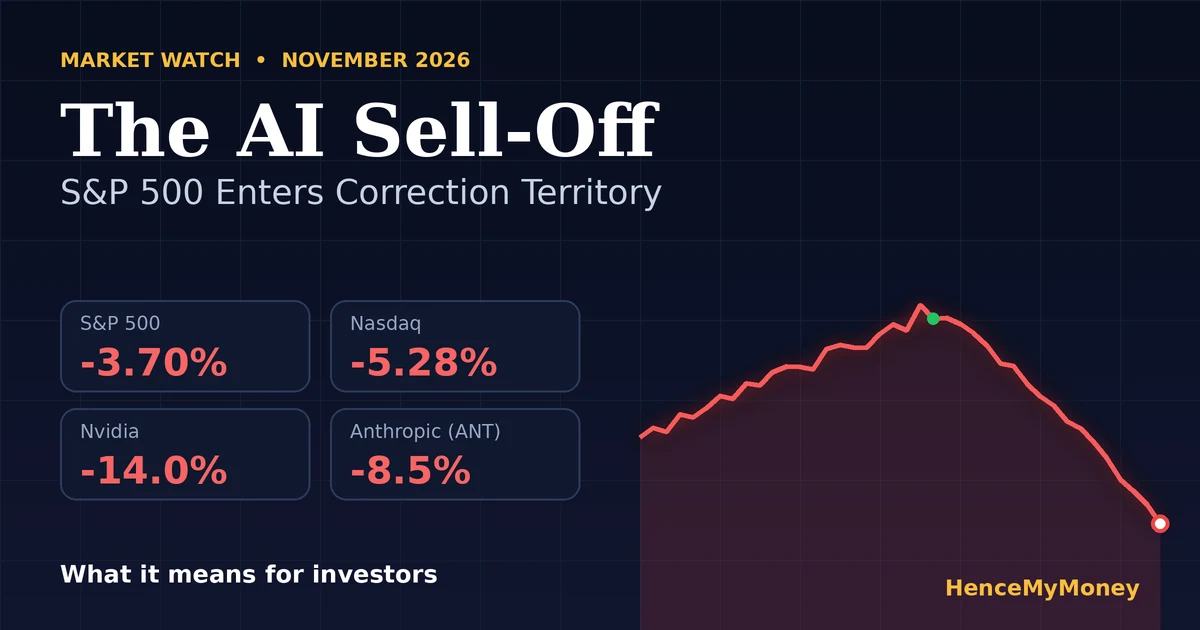
- The S&P 500 entered correction territory: The index fell 3.7% on November 20, closing at 6,910.39, more than 10% below its October record high.
- The Nasdaq turned negative for the year: Its 5.28% daily decline left the technology-heavy index approximately 2.7% lower in 2026.
- Anthropic’s IPO could not reverse market anxiety: Shares fell 8.5% on their second trading day, although they remained above the $83 offering price.
- Semiconductor companies suffered heavy losses: Nvidia, AMD, Micron and Broadcom all recorded double-digit declines.
- Investors are questioning AI spending: The central concern is whether enormous infrastructure investments will produce sustainable financial returns.
- Global markets are connected: The sell-off spread into Asian equities, particularly markets closely linked to semiconductor manufacturing.
- A correction is not automatically a crash: Further declines are possible, but the correction alone does not establish that a recession or financial crisis is coming.
- Investors should prioritise discipline: Diversification, adequate liquidity and a clear investment horizon can help manage market volatility.
1. A Brutal Friday on Wall Street: The S&P 500 Enters Correction Territory
November 20, 2026, was a difficult day for investors in the United States.
Selling intensified across technology and growth stocks, pulling major market indexes lower. The decline was particularly severe in companies associated with artificial intelligence and semiconductor manufacturing.
Here is how the major US indexes performed:
| Index | November 20 closing level | Daily change |
|---|---|---|
| S&P 500 | 6,910.39 | -3.70% |
| Nasdaq Composite | 22,617.73 | -5.28% |
| Dow Jones Industrial Average | 48,147.33 | -1.93% |
| Russell 2000 | 2,581.79 | -2.76% |
The S&P 500’s decline pushed it more than 10% below its October 6 record closing high. This placed the benchmark index in what financial markets commonly describe as correction territory.
The Dow Jones Industrial Average had also fallen more than 10% from its recent peak.
The Nasdaq experienced an even sharper decline. Its 5.28% fall on Friday left it approximately 2.7% lower for the year, erasing the gains it had accumulated during 2026.
The weekly figures were equally concerning:
- The S&P 500 fell approximately 8.6%.
- The Dow declined around 8%.
- The Nasdaq dropped approximately 10%.
- The Russell 2000 lost approximately 7.5%.
The Nasdaq’s weekly decline was particularly significant because technology companies have been among the biggest beneficiaries of the AI investment boom.
What does correction territory actually mean?
A market correction generally refers to a decline of at least 10% from a recent peak.
It is important to distinguish this from a bear market, which is commonly defined as a decline of 20% or more.
| Market condition | Common definition |
|---|---|
| Pullback | A relatively modest decline, often around 5%–10% |
| Correction | A decline of at least 10% |
| Bear market | A decline of at least 20% |
| Market crash | A particularly rapid and severe decline, without one universally accepted percentage threshold |
A correction does not automatically mean that an economic recession is approaching. Nor does it guarantee that stock prices will continue falling.
It indicates that investors are reassessing market valuations and expectations. Whether the decline becomes more serious depends on what happens next to corporate earnings, economic growth, interest rates and investor confidence.
2. Anthropic’s Historic IPO Could Not Restore Confidence in AI Stocks
One of the most interesting parts of the November sell-off was its timing.
Anthropic had just completed a record-breaking stock market debut on November 19. The company, known for developing the Claude family of AI models, listed on Nasdaq under the ticker symbol ANT.
The IPO was priced at $83 per share.
During its first trading session, the stock opened at $111.50 and closed at approximately $97.17. That represented a substantial gain over its offering price and initially suggested strong investor demand.
However, the second trading session told a different story.
On November 20, Anthropic shares fell 8.5%, closing at $88.91. During the session, they briefly touched $83.05, just five cents above the original IPO price.
| Trading milestone | Share price |
|---|---|
| IPO offer price | $83.00 |
| First-day closing price | $97.17 |
| Second-day closing price | $88.91 |
| Second-day decline | 8.5% |
Despite the decline, Anthropic shares remained approximately 7.1% above their IPO price at Friday’s close.
So why did the stock fall so quickly after such a successful debut?
The answer is that a successful IPO does not necessarily resolve questions about a company’s long-term financial performance.
Investors may be enthusiastic about a company’s technology and still have concerns about its valuation, profitability and spending requirements.
Anthropic operates in an industry where developing and running advanced AI models requires substantial computing resources. Those resources involve expensive processors, data centres, electricity, networking equipment and ongoing research.
The company may have significant growth opportunities, but investors still need to understand how much it will cost to capture them and how quickly that investment can generate sustainable returns.
There is also a broader market consideration.
Anthropic’s listing took place while investors were already reducing exposure to technology stocks. Its successful first trading session could not reverse the wider selling pressure.
The lesson is straightforward: a company’s IPO performance and the overall health of its industry are two different things.
A new stock can attract strong initial demand even while investors are becoming more cautious about the wider sector.
3. Semiconductor Stocks Bear the Brunt of the AI Sell-Off
If artificial intelligence represents the investment theme, semiconductor companies provide much of the infrastructure behind it.
Advanced chips are essential for training and running large AI models. Memory products, networking equipment and specialised processors also play important roles in the expansion of AI data centres.
That connection has made semiconductor manufacturers major beneficiaries of the AI investment cycle.
It has also made them vulnerable when investors begin questioning whether the spending can continue at its current pace.
On November 20, several major semiconductor companies experienced steep losses.
| Company | Approximate daily decline |
|---|---|
| Nvidia | -14.0% |
| Micron Technology | -13.9% |
| AMD | -13.3% |
| Broadcom | -12.2% |
These declines show how quickly investor sentiment can change when a sector that has performed strongly becomes the focus of a broader reassessment.
Consider the different roles these companies play:
- Nvidia: Supplies graphics processing units and other computing technology used in AI training and inference.
- AMD: Develops processors and AI accelerators used in data centres and computing systems.
- Micron Technology: Manufactures memory products that support high-performance computing.
- Broadcom: Supplies semiconductor and networking technologies used in data-centre infrastructure.
When investors become concerned about future AI infrastructure spending, companies supplying that infrastructure can experience selling pressure.
This does not necessarily mean demand for their products has disappeared. It means investors are reconsidering the growth expectations and valuations already reflected in their share prices.
Why Nvidia remains central to the market story
Nvidia has become one of the most important companies associated with the AI investment boom.
Its processors are widely used in AI data centres, making the company a major beneficiary of spending by cloud providers and technology businesses.
However, its shares had already been under pressure before the November 20 sell-off.
Nvidia closed at $125.53 on Friday, down approximately 14% for the session. The company had also recorded seven consecutive weekly declines.
The combination of a prolonged share-price decline, leadership uncertainty and regulatory scrutiny has added to investor caution.
But it is important to distinguish between the performance of a company’s shares and the performance of its underlying business. A falling share price does not, by itself, establish that a company has lost its competitive position or that its long-term business prospects have collapsed.
Investors need to examine financial results, future demand, competition, spending requirements and valuation before reaching that conclusion.
4. Why Are Investors Suddenly Questioning the AI Boom?
This is the central issue connecting Anthropic’s IPO, Nvidia’s decline and the wider market correction.
For much of the AI boom, investors rewarded companies that appeared well positioned to benefit from the technology.
Technology giants and semiconductor manufacturers announced enormous infrastructure investments. Data-centre construction expanded, demand for advanced processors increased, and expectations for AI-related revenue grew.
But enthusiasm is now being tested by a more difficult financial question:
Will the money being invested in AI generate enough future profit to justify the cost?
Building AI infrastructure requires much more than purchasing a few processors.
Companies need to invest in:
- Advanced semiconductor chips and computing systems.
- Large-scale data centres.
- Electricity generation and power connections.
- Cooling systems and networking equipment.
- Cloud computing capacity.
- AI research, model development and engineering talent.
These investments can create long-term opportunities, but they also involve substantial upfront costs.
Imagine a technology company commits $100 billion to expand its AI infrastructure.
Investors will want to understand how much additional revenue the investment could generate, how long it will take to recover the money and whether the resulting business will produce attractive profit margins.
If those answers become less convincing, the market may reduce the valuation it assigns to the company.
This is particularly important when share prices already reflect expectations of rapid future growth.
A company can report strong revenue growth and still experience a falling share price if investors believe its future performance will not justify its valuation.
That is why the current sell-off should not automatically be interpreted as a rejection of artificial intelligence.
The bigger issue is whether the financial returns from AI will be sufficient to support the enormous investments being made today.
5. The Sell-Off Is Spreading Beyond Wall Street
The November 20 decline was not confined to American stock exchanges.
Asian markets also experienced significant pressure as investors reacted to the weakening technology trade and concerns about global risk appetite.
According to Reuters reporting on November 20, the MSCI Asia-Pacific index excluding Japan fell sharply. Japan’s Nikkei and South Korea’s KOSPI also recorded substantial declines.
Taiwan’s market came under particular pressure because of its close connection to the global semiconductor industry.
This matters because the AI infrastructure supply chain is international.
Companies in the United States may design processors, while manufacturing, memory production, packaging, networking and other parts of the supply chain involve businesses across Asia.
When investors reduce exposure to the AI trade, the effects can therefore spread across several countries and industries.
Why are investors also watching interest rates?
Interest rates add another layer of uncertainty.
When borrowing costs remain elevated, companies may find it more expensive to finance infrastructure expansion. Higher rates can also affect how investors value businesses whose expected profits lie several years in the future.
For technology companies with high valuations, this can become particularly important.
Investors may become less willing to pay a premium for future growth when safer investments offer more attractive yields.
Inflation and Federal Reserve policy therefore remain important factors to watch.
However, it would be misleading to attribute the entire November 20 decline to interest rates. The immediate selling pressure was closely associated with concerns about AI valuations, technology spending and the broader market’s willingness to maintain exposure to expensive growth stocks.
Data-centre expansion also faces practical challenges
The AI infrastructure boom depends on more than investor funding.
Companies need electricity, land, construction capacity, equipment, permits and access to financing to build data centres.
Delays or restrictions in any of these areas can affect project costs and timelines.
As AI infrastructure expands, questions about energy consumption, local environmental impacts and regulatory approval are becoming increasingly important.
These challenges do not mean data-centre expansion will stop. They do mean that the industry’s growth may be more complicated and expensive than some optimistic projections suggest.
6. What Does the Market Correction Mean for Investors in India?
For Indian investors, a sharp fall on Wall Street can create uncertainty even when their portfolios are primarily invested in domestic stocks or mutual funds.
The connection between global markets and Indian investments works through several channels.
Global investor sentiment and capital flows
When international investors become cautious about risk, they may reduce exposure to emerging markets and other equity investments.
This can influence foreign institutional investment flows into Indian equities.
However, foreign investor activity is only one factor affecting the Indian market. Domestic institutional investors, retail participation, corporate earnings and economic conditions also play important roles.
Indian IT companies may face different pressures
A decline in US technology stocks does not automatically mean every Indian IT services company will experience the same business impact.
Semiconductor manufacturers, AI model developers, cloud infrastructure providers and IT services companies operate different business models.
For example, Indian IT companies may benefit from businesses adopting AI tools, while also facing pressure if clients reduce technology budgets or delay discretionary projects.
The impact depends on actual customer demand, contract growth, pricing and the company’s ability to adapt.
International investments may feel the decline directly
Investors holding US equity funds, international index funds or individual American technology stocks may experience direct effects from the sell-off.
They should also remember that international investments involve currency risk. Changes in the value of the US dollar against the Indian rupee can influence the rupee value of overseas holdings.
The important point is not to assume that every global market decline requires an immediate change in an Indian investor’s portfolio.
Domestic fundamentals and individual financial goals still matter.
7. What Should Everyday Investors Do During a Market Correction?
Market corrections can be uncomfortable, particularly when they happen quickly and involve companies that were previously considered market leaders.
However, investors do not need to predict the exact bottom or react to every negative headline.
A few practical habits can help maintain financial discipline.
1. Understand what you actually own
A portfolio may contain several stocks or mutual funds but still be heavily exposed to the same industry.
For example, holding a technology mutual fund, a semiconductor ETF, a nd individual AI-related shares may create significant overlapping exposure.
Review the underlying holdings rather than judging diversification only by the number of investments.
2. Keep near-term money separate
Money needed for essential expenses or planned commitments over the next one to three years should generally not depend on volatile equity markets.
Maintaining an emergency fund and keeping short-term savings in suitable liquid, lower-risk instruments can reduce the possibility of being forced to sell investments during a downturn.
3. Avoid trying to predict every market bottom
Nobody knows exactly when a correction will end.
Investors who wait for complete certainty may miss part of a recovery. Those who invest all their available money too early may face further declines.
For long-term investors, a disciplined investment schedule can reduce the pressure of trying to identify the perfect entry point.
4. Reassess business fundamentals
A falling share price deserves attention, but it should not be the only reason to buy or sell.
Review revenue growth, profitability, debt, cash flow, competition and future demand.
A company whose share price has fallen because of temporary market sentiment may be in a different position from one whose business model is deteriorating.
5. Keep your investment strategy connected to your goals
A portfolio designed for a long-term retirement goal should not necessarily be managed in the same way as money required for a house purchase next year.
Your time horizon, liquidity requirements and ability to tolerate losses should guide your asset allocation.
If your portfolio’s risk is higher than you can comfortably manage, consider reviewing its allocation rather than making impulsive trades in response to market headlines.
The Bottom Line: Is Wall Street Losing Confidence in AI?
Not necessarily.
The latest market correction suggests that investors are becoming more selective about how they invest in artificial intelligence.
For a long time, companies associated with AI benefited from enormous optimism about future demand. But as infrastructure spending increases and valuations remain under scrutiny, investors are asking more difficult questions about profitability, cash flow and the time required to recover these investments.
Anthropic’s historic IPO, its second-day decline, Nvidia’s prolonged share-price weakness and the S&P 500’s correction are different developments connected by this broader reassessment.
The opportunity presented by artificial intelligence may remain enormous. But a promising technology does not guarantee that every company involved will become a successful investment at every price.
For everyday investors, the lesson is not to abandon the market whenever technology stocks fall. It is to understand the risks, avoid excessive concentration, protect money needed in the near term and make investment decisions based on financial goals rather than daily headlines.
The AI story may still have a long way to go. But Wall Street is making one thing clear: enthusiasm about a technology and confidence in the price of its stocks are not the same thing.
Disclaimer: This article is for informational and educational purposes only. It does not constitute financial, legal, employment or career advice. Layoff figures come from third-party trackers and company statements and may be revised. Please consult official company announcements and a qualified professional when making employment decisions.