
Anthropic’s IPO was supposed to be the moment AI stocks got their confidence back. For a few hours on November 19, it looked that way. Then the Nasdaq reversed, chip stocks sank, and Asia opened the next morning in the red. A record listing, it turned out, can’t fix a worry that’s about the whole sector.
Key Takeaways
- A record IPO. Anthropic priced 980 million shares at $83, raised $81.3 billion and valued itself at about $1.5 trillion on a fully diluted basis.
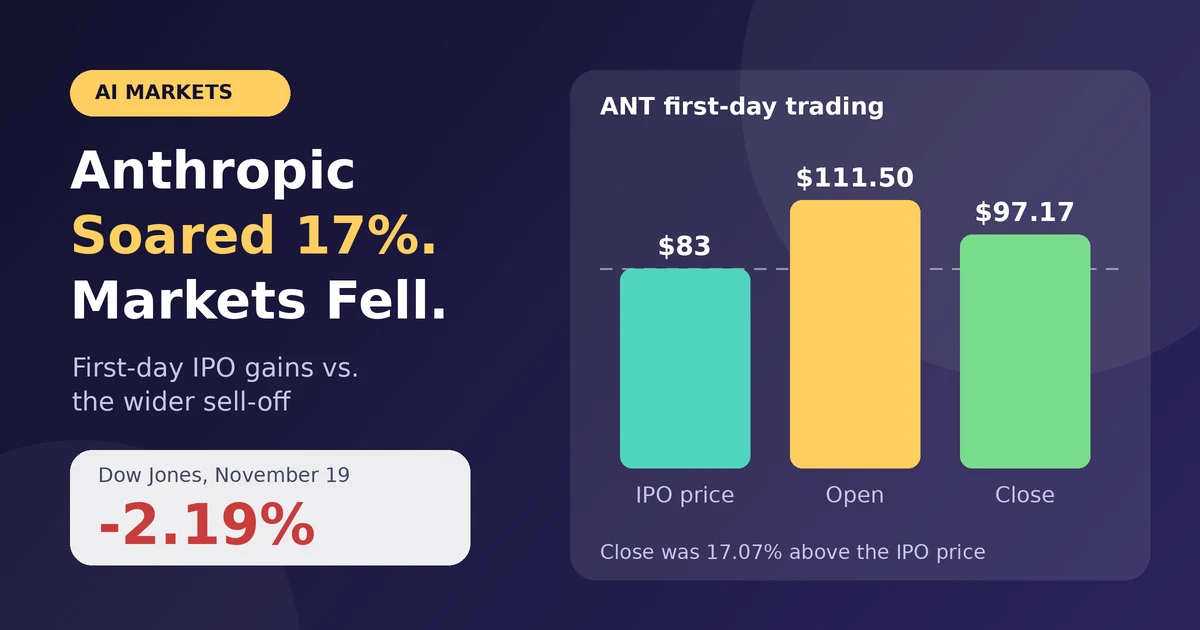
- A strong but uneven first day. It opened at $111.50, hit $115.10 and closed at $97.17, 17.07% above the IPO price and 12.85% below its opening trade.
- The market fell anyway. The Dow, S&P 500 and Nasdaq all lost more than 2% on November 19.
- Chip stocks took the hit. Nvidia fell 3.3%, and AMD closed near 8% after a short-seller report.
- Asia followed on November 20. The Nikkei fell as much as 4.5% and the Kospi more than 4% early on.
- The question is profit, not demand. Investors want proof that huge AI spending turns into earnings.
A record debut
Anthropic priced its IPO on the evening of Wednesday, November 18, at $83 a share, above the $70 to $78 range it had marketed. It also upsized the deal, selling 980 million shares instead of the 825 million it had initially planned. Of those, the company sold about 956 million, and its seven co-founders sold the rest. Together, that raised $81.3 billion, the largest IPO ever, ahead of SpaceX’s $75 billion offering in June. A separate $26 billion private placement at the IPO price sits on top of that.
Demand was heavy. One report said orders outpaced the available shares by nearly seven times, even as concerns about an AI bubble hung over tech stocks. The distinction between the two raises is worth keeping straight: $81.3 billion came from the public IPO, and the $26 billion came from a private placement.
A day of two halves
Shares began trading on Nasdaq on Thursday, November 19, under the ticker ANT. They opened at $111.50, touched $115.10 and then slid to close at $97.17. That’s still a 17.07% gain on the $83 offer price, and one report put the company’s value at roughly $1.76 trillion at the close. But it closed 12.85% below its open, showing how much of the early enthusiasm evaporated.
The broader market did something similar. The S&P 500 was up as much as 1.3% early, helped by anticipation of the listing, then reversed to finish down 2.02% for its sixth straight loss. That was its biggest intraday reversal since November 20, 2025, according to Dow Jones Market Data. The Dow dropped 1,101 points, with only one of its 30 stocks finishing higher.
| Index | November 19 move | Close |
|---|---|---|
| Dow Jones Industrial Average | -2.19% | 49,097.06 |
| S&P 500 | -2.02% | 7,175.83 |
| Nasdaq Composite | -2.25% | 23,879.20 |
Why one hot IPO couldn’t lift the rest
It’s tempting to read a record listing as proof that investors still love AI. A better reading is that investors love certain AI exposure at certain prices. Money for a $107 billion combined raise has to come from somewhere, and some Asian traders said as much, citing selling in other assets to buy the new shares. When a single stock absorbs that much capital in a nervous market, others can end up funding it.
I’d also say the debut and the sell-off are two answers to the same question. Anthropic’s demand shows investors want to own the AI developers. The wider sell-off shows they doubt whether the vast spending around them will pay off. Both can be true on the same day.
Nvidia: a good report that still didn’t help
Nvidia was supposed to be the reassurance. It reported results ahead of expectations, its first earnings report since Jensen Huang’s sudden resignation as CEO, yet the post-earnings rally fizzled. On November 1,8 it finished down 2.9% at about $151, and on November 19 it fell another 3.3%, in what Kiplinger called one of the year’s most volatile sessions.
The lesson is an old one: when expectations are extreme, even good news can disappoint. Investors weren’t asking whether Nvidia could beat a forecast. They were asking whether the buildout it sells into can keep growing fast enough to justify its price.
AMD and the short seller
AMD had its own problem. Hunterbrook Media published a report saying that a blacklisted Chinese server maker had incorporated newer versions of AMD’s firmware into its products, which raised concerns about export-control scrutiny. Hunterbrook’s affiliated fund also disclosed a short position, meaning it profits if AMD’s shares fall. AMD fell more than 9% at one point and closed down close to 8%.
A few things are worth keeping separate. The report is an allegation, not a finding. AMD denied it, saying the claims misrepresent its business practices and relationships. And a short seller has a financial interest in the stock falling, which isn’t proof that the report is wrong but is a reason to read it carefully. Regulators and the company’s own answers will matter more than the first-day price reaction.
Asia feels it the next morning.ng
Asian chip and AI stocks fell sharply on Friday, November 20. In Tokyo, the Nikkei fell as much as 4.5% to below 57,000, with chip-testing firm Advantest, SoftBank Group and memory maker Kioxia leading the decline. In Seoul, the Kospi dropped more than 4%, and SK Hynix and Samsung Electronics each fell more than 5%. Other regional markets also traded lower. Those are early-session moves, so check closing levels before publishing.
The pattern should look familiar if you read our earlier piece on the November 5 sell-off. South Korea is central to memory chips, Japan supplies chip equipment and materials, and Taiwan’s TSMC makes advanced processors. When US investors question AI spending, the companies that supply the buildout feel it first, often before a single order has been cut.
The valuation question
Anthropic itself shows why investors are cautious. Its recent filings show revenue of about $16.96 billion in the third quarter, up from about $1.38 billion a year earlier, alongside a $567 million operating loss in that quarter. Reuters-based figures in your sources add that it spent around $9 billion on computing infrastructure in the first half of 2026 and about $5 billion more in the third quarter, with enormous long-term commitments for future capacity. The Guardian has put the commitments at roughly $900 billion over two decades. I’d verify those two figures before you print them.
Growth and profit aren’t the same thing. A company can double its sales and still spend more than it earns. That’s why a stock valued at more than a trillion dollars needs investors to believe in profits years ahead, not just revenue now.
Some commentary has compared this moment to the dot-com era. The comparison is easy to make and hard to prove. The internet did transform the economy even though many stocks in that boom collapsed, so the analogy is a reminder that a technology can be real and its share prices still wrong. It isn’t a prediction.
Other pressures
Anthropic’s debut wasn’t the only story. Some market coverage that day pointed to inflation worries and the possibility of higher interest rates, which raise the cost of the borrowing that funds data centres and make investors less willing to pay for profits far in the future. Together with the Huang resignation, the AMD allegations and export-control questions, there were a lot of reasons to sell on the same day. That’s a good reason to be careful about pinning the whole move on any single cause.
What this means for ordinary investors
- The IPO price isn’t the trading price. Retail investors can’t usually buy at $83, and the first-day close was $97.17. Whatever you pay is the price that matters.
- A good company isn’t a good price. A strong business can still be a poor purchase if expectations are extreme.
- Don’t confuse one stock with a sector. Anthropic rose while Nvidia, AMD and the Dow fell, so one company’s success didn’t carry the others.
- Expect big swings. A stock that opens 34% above its offer price and closes 17% above it shows how quickly sentiment can move.
- Watch concentration. If AI names are a large part of your portfolio through funds, a sector-wide sell-off hits you even if you never buy any single stock.
What to watch next
- How ANT trades once the excitement fades. Strong first days are often followed by volatility.
- Chip stocks and export rules. AMD’s response and any regulatory follow-up will matter.
- Nvidia’s leadership. Investors want clarity on succession.
- Interest-rate signals. Higher rates make AI’s financing costs harder to carry.
- Evidence of profits. Revenue growth only calms the market if margins and cash flow follow.
The bottom line
Anthropic’s debut was a real milestone, and the demand behind it was real too. But a record listing isn’t a verdict on the whole AI trade. On the same day it soared, the Dow lost 1,101 points, chip stocks fell, and Asia followed. Investors aren’t walking away from AI. They’re asking a harder question than they did a year ago: not whether the technology works, but how much of the money being spent will come back as profit.
The IPO gave the market one answer: that people still want in. The sell-off gave another: that they want it at the right price. Both will keep colliding for a while.
Disclaimer: This article is for informational and educational purposes only. It does not constitute financial or investment advice or a recommendation to buy, sell or hold any security. IPO and trading figures are snapshots of November 19 and 20, 2026, not live prices. Allegations about AMD are claims that have not been proven. Please do your own research or consult a qualified financial adviser before investing.