
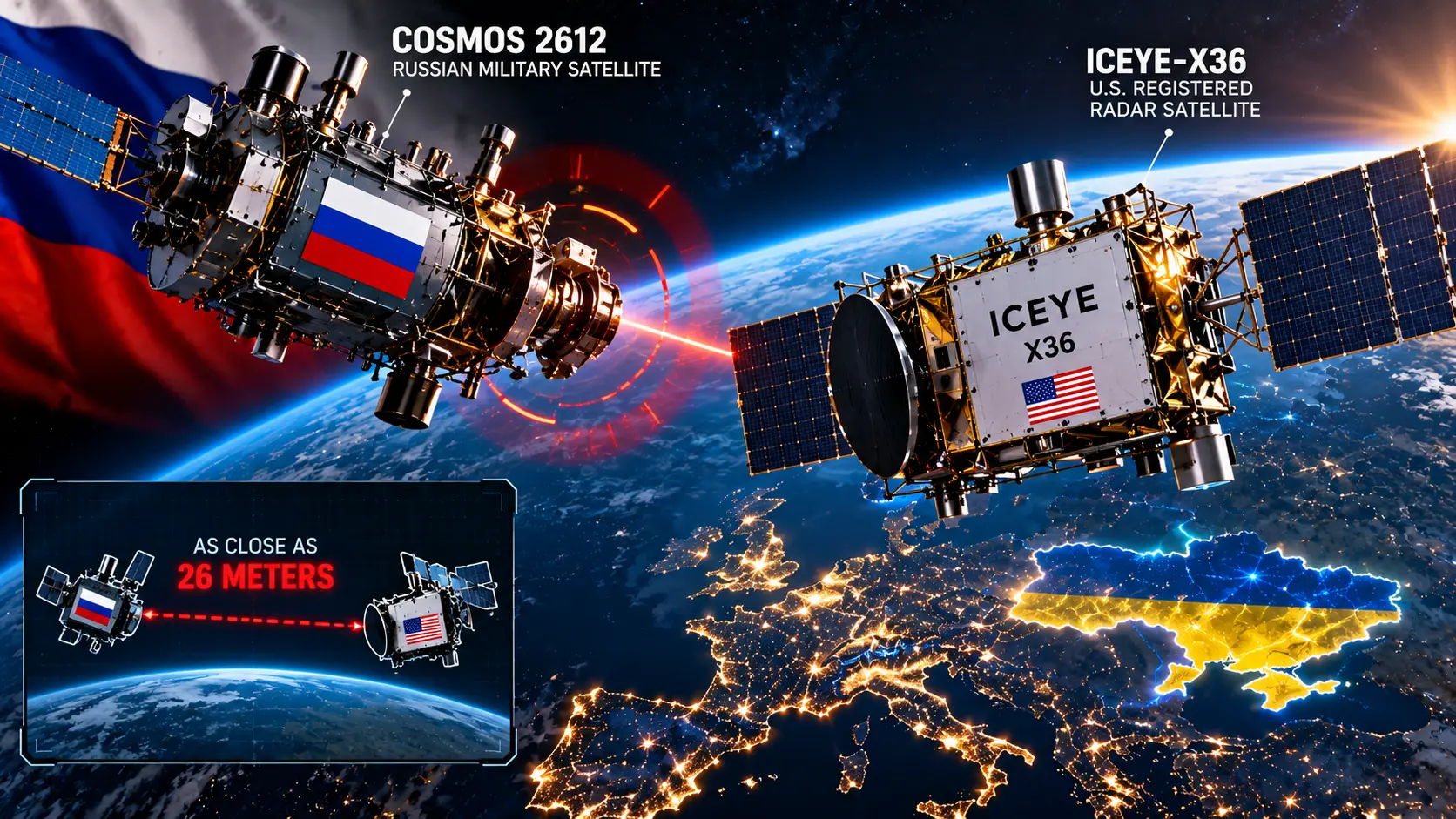
A developing space security incident is drawing attention to the growing competition between russia and western-linked space assets. Russia’s military satellite Cosmos 2612 reportedly maneuvered into extremely close proximity with ICEYE-X36, a commercial radar-imaging satellite registered in the United States and operated by finland-founded ICEYE
The encounter has raised questions about satellite surveillance, military intelligence and the safety of commercial spacecraft operating in low earth orbit. Because ICEYE provides radar imaging capabilities that have supported Ukraine, the incident has attracted particular interest among security analysts.
However an important distinction must be made: the available orbital tracking reports indicate a deliberate series of maneuvers, but they do not establish that Russia attempted to damage, disable or interfere with the other satellite.
The episode highlights a broader for governments and commerical space companies. As satellite become increasingly important to national security, the space surrounding Earth is becoming a more sensitive arena for strategic competition.
what happened between cosmos 2612 AND ICEYE-X36 ?
Independent satellite trackers reported that cosmos 2612 significantly changes its orbit before approching ICEYE-X36 in October 2026. instead of simply pasing through the same general region of space, the Russian spacecraft reportedly adjusted it’s orbital path to remain close to the commercial satellite.
Astronomer Jonathan McDowell described the encounter as an unusual, apparently unapproved rendezvous between two active satellites in low Earth orbit. Other orbital analysts also pointed to a sequence of maneuvers consistent with an intentional approach.
The reported seperation has varied across tracking accounts. Some analyses suggested that tha satellite may have approached within a few hundred metres while another report based on satellite-traking data described a separation as a small as 26 meters on October 19, 2026.
These figures should not be treated as equally confirmed measurements. Public orbital data can contain uncertainties, particularly when calculating the precise distance between two spacecraft moving at High speeds. A definitive minimum seperations would require sufficently accurate tracking information.
How did the Russian satellite reach such a close position ?
A series of calculated orbital maneuvers
Moving a satellite into a specific Position requires more than changing its direction. Engineers must account for orbital altitude, velocity, inclination and the gravitational forces affecting the spacecraft. Even a relatively small adjustment can influence where a satellite travels overtime.
According to publicly reported tracking analyses, cosmos 2612 performed a series of maneuvers intended to bring its orbit closer to that of ICEYE-X36. Such adjustments consume propellant, which is a limited resources for most operational satellites.
Fuel consumption alone does not prove hostile intent. Close-proximity operations can have legitimate purposes, including inspecting spacecraft or testing orbital capabilities, however, repeated adjustments toward another satellite without its operator’s consent can create reasonable security concerns.
Why ICEYE-X36 Matters to Ukraine
ICEYE-X36 is a part of a commercial radar-imaging environment that has attracted attention because of ICEYE’s cooperation with ukraine
The importance of radar imaging
Synthetic aperture radar, commonly known as SAR, allows satellites to collect useful images of earth’s surface at night and through cloud cover. This makes the technology valuable when conventional optical imaging is limited by darkness or weather.
Radar imagery can help identify changes in buildings, roads, terrain and other infrastructure depending on the circumstances, it can support disaster response, environmental monitoring and military intelligence.
ICEYE established a partnership with ukraine in 2022 to provide access to satellite-imaging capabilities. However, a public reporting has not conclusively established that ICEYE-X36 itself was directly assigned to Ukrainian military operations.
The distinction is important. The company’s broader co-operation with ukraine explains the geopolitical interest in the encounter, but it does it establish the specific mission of this individual satellite.
Could the encounter create a security risk ?
A satellite approaching another spacecraft may have an opportunity to observe it’s structure or behaviour, depending on its equipment and position. In some circumstances, close-proximity operations can also create risks of interference or physical damage.
Nevertheless, proximity does not automatically means an attack is underway. Establishing hostile intent requires evidence beyond the distance between two objects.
The United States and European countries face a broader challenge as commercial satellite become increasingly important to national security. These spacecraft may provide valuable services to governments while remaining privately operated infrastructure.
An incident involving one satellite can therefore raise questions about the safety of other commercial spacecraft operating in strategically important orbits.
What should happen next ?
Continued tracking will help analysts determine whether cosmos 2612 remains near ICEYE-X36 or moves away. Information from the satellite cloud also establish whether the encounter affected the spacecraft’s performance.
Government and space agencies must access unusual orbital activity carefully, distinguishing confirmed facts from possible explanations. Better communication between satellite operators and authorities could help reduce uncertainty and support a proportionate response to genuine threats.
International co-operation will also be important. As more countries are private companies depend on orbital infrastructure, clear expectations for responsible behaviour can help prevent misunderstanding from escalating.
Conclusion: protectimg the future of space security
The reported encounter between cosmos 2612 and ICEYE-X36 highlights the growing connection between commercial space technology and international security.
Although the reported maneuvers deserve attention, the available evidence does not establish that Russia Attempted to damage or disable ICEYE-X36. Further technical information is needed to determine the space crafts intentions and whether any operational consequences occurred.
As satellite networks become more important to communications intelligence and everyday infrastructure, protectiny them will be required reliable tracking, responsible decision-making and stronger international coordination.
The central question is no longer simply how close one satellite can approach another. It is how the international community can prevent a close encounter from becoming a dangerous confrontation.