
Data as of October 2026. For education only; not investment advice.
When crude oil climbs past $100, nearly every energy producer looks like a genius. Disruptions to Middle East oil infrastructure pushed Brent as high as $131 this year, and Chevron and ExxonMobil have each gained roughly 50% over the past twelve months.
Owning energy stocks during a price spike is the easy part. The harder question is which of the two is better placed for the cooldown that official forecasts expect.
At a glance:
- Chevron is the sharper bet on oil: higher yield, more upside when crude rises, a thinner cushion when it falls.
- ExxonMobil is the steadier all-rounder: lower yield, lower breakeven, less debt, and refining and chemicals that help in a downturn.
A glide path downward
The US Energy Information Administration (EIA) expects Brent to average about $105 in the fourth quarter of 2026. It then sees prices easing to roughly $87 by mid-2027 and $74 by the end of 2027, as supply recovers and inventories rebuild. The agency also warns that short-term swings could be larger than its forecast implies.
Upstream purity vs. downstream armour
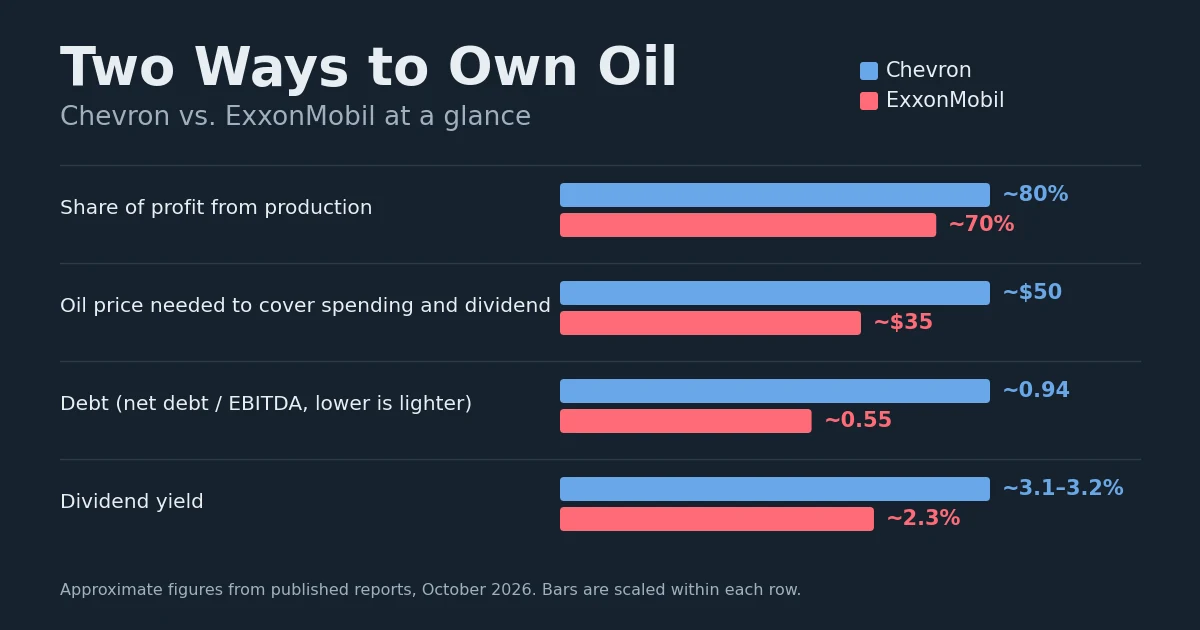
Chevron is the purer bet on extraction. Roughly 80% of its profit comes from producing oil and gas, so its earnings track crude closely.
ExxonMobil earns about 70% of its profit upstream. The rest comes from refining, chemicals, and speciality products. When crude weakens, those units often hold up better, provided the gap between crude and fuel prices stays steady.
By the numbers
| Chevron | ExxonMobil | |
|---|---|---|
| Share price (mid-Oct 2026) | ~$222 (record close) | ~$178 |
| Dividend yield | ~3.1–3.2% | ~2.3% |
| Consecutive annual dividend raises | 39 | 43 |
| Payout ratio | ~67% | ~53% |
| Oil price to cover capex + dividend | ~$50 | ~$35 |
| Net debt / EBITDA | ~0.94 | ~0.55 |
| Forward P/E | ~15.2 | ~14.8 |
Approximate figures from published reports, October 2026. Verify against company filings before relying on them.
The breakeven gap matters most. Even at the EIA’s late-2027 forecast of $74, both companies would cover their capital spending and dividends. ExxonMobil would clear its breakeven by about $39 and Chevron by about $24.
Valuation looks cheaper than it is. Both trade near 15 times expected earnings, but those earnings are boosted by the price spike. Chevron’s operating margin was about 21% last quarter, against under 9% in each of the three before it. If analysts are right that its earnings fall about 11.5% in 2027, the same price works out nearer 17 times earnings.
The dividend is not the main draw. With 10-year Treasuries yielding about 5%, a 2–3% payout doesn’t pull much weight. Both companies plan about 3% annual production growth, and that growth is the real argument.
How safe are the dividends?
The best test is 2020. ExxonMobil’s operating cash flow (about $14.7 billion) fell short of its capital spending (about $17.3 billion), yet it still paid roughly $14.9 billion in dividends by borrowing, and debt rose by about $20.7 billion. Today its balance sheet is lighter. Free cash flow covered the dividend 1.84 times in 2024 and 1.37 times in 2025, and about 1.2 times even with Brent near $64. In a downturn, buybacks would likely be cut before the dividend.
Chevron is also financially sound, but its higher payout ratio and tighter breakeven leave less room for error.
The illusion of diversification
Owning both stocks doesn’t spread your risk as much as it seems. Chevron’s Hess acquisition gave it a 30% stake in Guyana’s Stabroek Block. ExxonMobil is also expanding in Guyana, alongside the Permian Basin, where its Pioneer acquisition added scale. Both are leaning on the same growth engine, so holding both largely doubles the same bet.
Three scenarios
| If oil… | Likely effect |
|---|---|
| Stays above $100 | Chevron gains more per dollar of crude. ExxonMobil benefits too, with refining as a second engine. |
| Follows the EIA path ($87 by mid-2027, $74 by late 2027) | Earnings fall at both. Chevron’s record price and higher payout leave it more exposed; ExxonMobil’s lower breakeven helps. |
| Drops below $60 for a long stretch | ExxonMobil’s lower breakeven and debt give it the edge. Chevron’s dividend would face more pressure. |
What to watch on October 30
Both companies report that day. Watch refining margins (ExxonMobil has flagged a boost of roughly $4.5 billion), production growth against the 3% target, free cash flow after dividends, and any change in guidance if oil falls.
The bottom line
The choice comes down to your view of oil.
If you think tensions will keep crude above $100 well into 2027, Chevron is the sharper way to play it, with the caveat that you’d be buying near a record price with a thinner cushion.
If you agree with the EIA’s expectation of a cooling market, ExxonMobil looks like the more comfortable holding. Its lower breakeven, lighter debt, and refining business give it more room if prices retreat. Whichever you prefer, both stocks rise and fall with the same commodity, so neither is a safe harbour.
This article is for education only and is not investment advice. Do your own research or consult a licensed financial advisor before investing.
Sources: US Energy Information Administration (October 2026 Short-Term Energy Outlook); Motley Fool; Insider Monkey; Trefis; 24/7 Wall St.; Zacks. Data as of October 2026.