
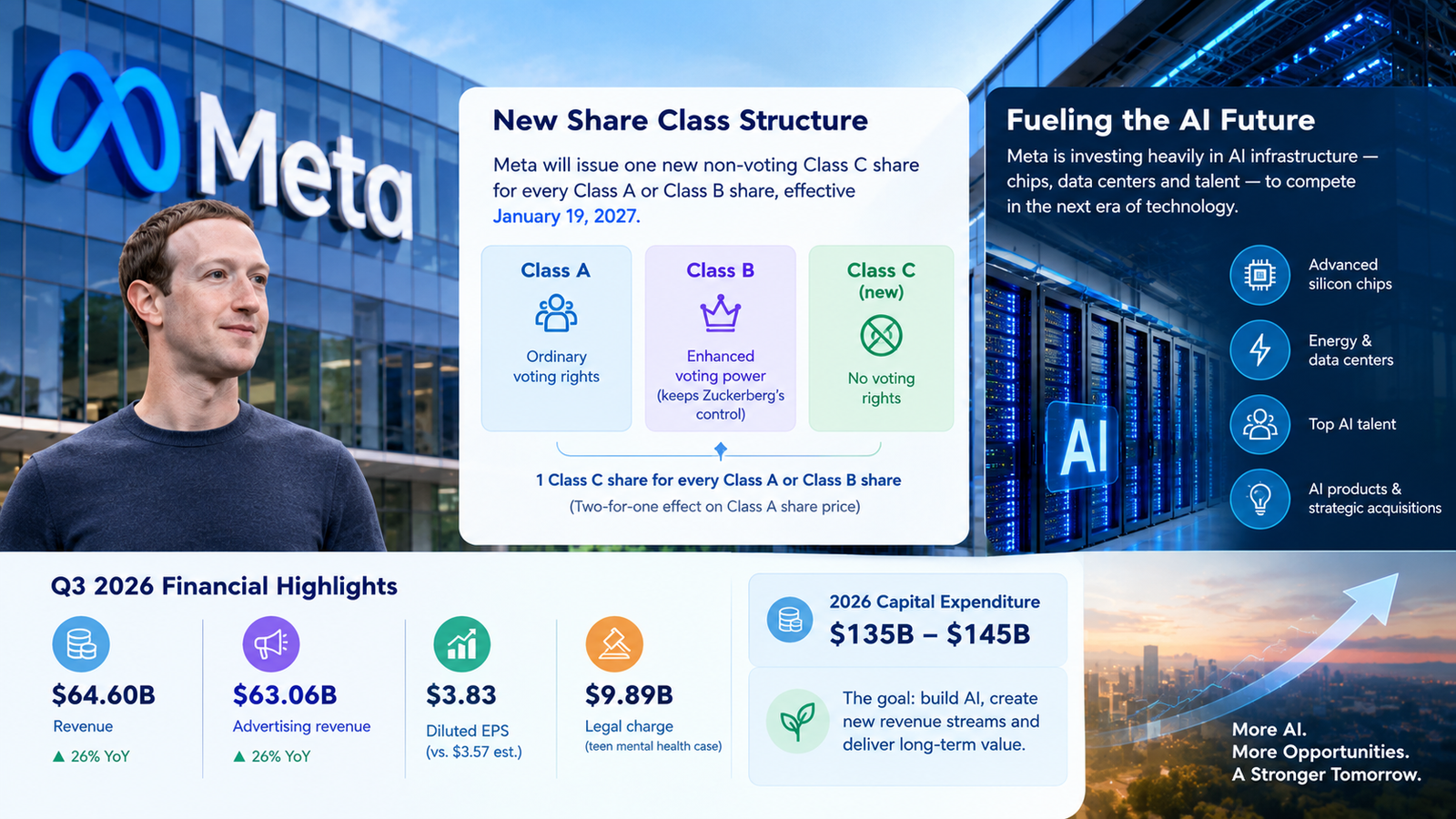
Meta is introducing non-voting shares to create greater financial flexibility for its AI ambitions—while preserving its existing voting structure.
At a glance
- Meta plans to distribute one new non-voting Class C share for every existing Class A or Class B share, subject to the required corporate steps.
- The arrangement is expected to create a two-for-one stock-split effect for Class A shares, without changing shareholders’ voting power.
- Third-quarter 2026 revenue reached $64.60 billion, up 26% year over year.
- Meta expects capital expenditure of $135 billion to $145 billion in 2026.
Imagine a successful shop that earns money from thousands of regular customers. Now, its owner wants to build a much larger business next door—one that requires expensive equipment, electricity and years of investment before delivering its full potential.
That is the challenge facing Meta Platforms, the company behind Facebook, Instagram and WhatsApp. Its advertising business continues to generate substantial revenue, but its next major ambition is artificial intelligence (AI), an industry where building the infrastructure can cost billions before the returns become clear.
Meta’s proposed new share structure is part of its response to this challenge. It aims to give the company more flexibility to raise capital, compensate employees and pursue acquisitions without changing the voting power of existing shareholders.
What Meta Is Actually Doing
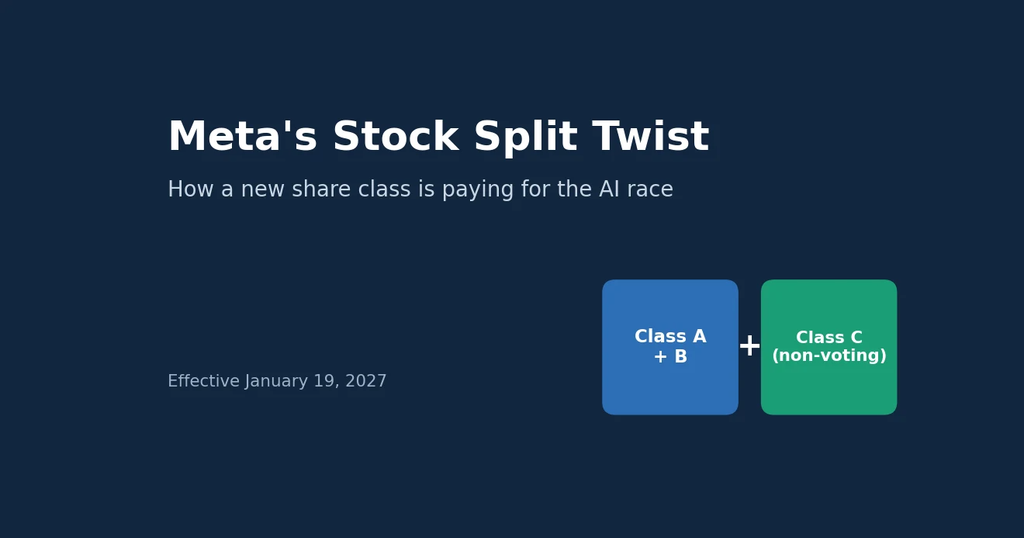
Meta has announced plans to establish a third class of common stock: Class C shares. Unlike its existing share classes, these new shares will carry no voting rights.
Under the announced arrangement, shareholders will receive one Class C share for each Class A or Class B share they hold. The new class is intended to become effective on January 19, 2027, subject to the required corporate filing. The board will determine the stock dividend’s record and payment dates separately.
Here is the basic difference between the three classes:
| Share class | Voting rights |
|---|---|
| Class A | Ordinary voting rights |
| Class B | Enhanced voting power, helping preserve founder control |
| Class C | No voting rights |
The important detail is that Meta is not simply carrying out a conventional stock split. It is creating a new class of shares and distributing them as a one-time stock dividend. Meta expects the market price of its Class A shares to reflect a two-for-one split effect after the dividend is paid.
What Does a Two-for-One Effect Mean?
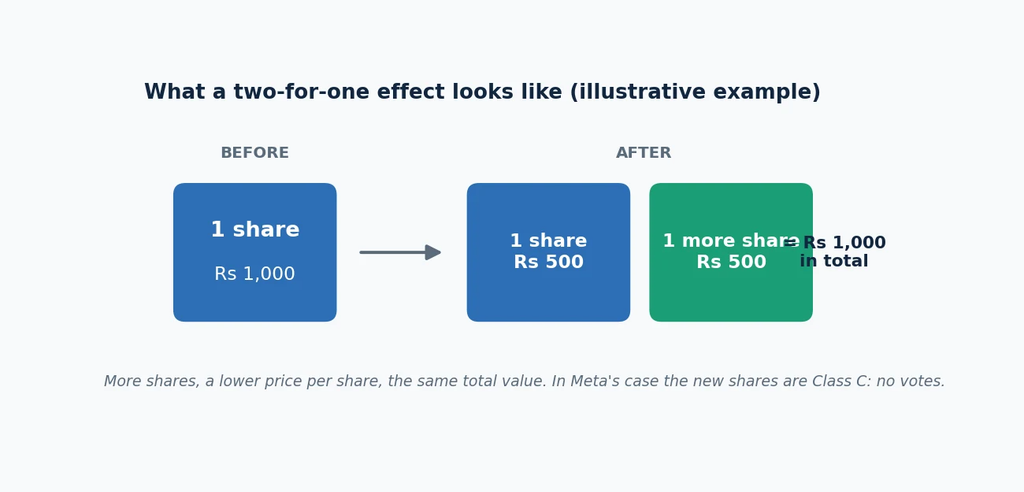
Suppose you own one share worth ₹1,000. After an illustrative two-for-one split, you might own two shares worth approximately ₹500 each.
You now have twice as many shares, but their combined value remains approximately ₹1,000. The transaction does not automatically make you wealthier; the market price can still rise or fall.
Meta’s arrangement is more specific because the additional shares will be non-voting Class C shares. The main purpose is to provide flexibility for capital raising, employee compensation, acquisitions and other corporate needs while keeping voting power unchanged.
One distinction matters: issuing shares as a dividend does not itself bring new cash into Meta. The company would need to sell shares or use them in a transaction to obtain financing or acquire something of value.
The Engine: Advertising Still Pays the Bills
Meta’s AI ambitions rest on a business that is already generating substantial revenue.
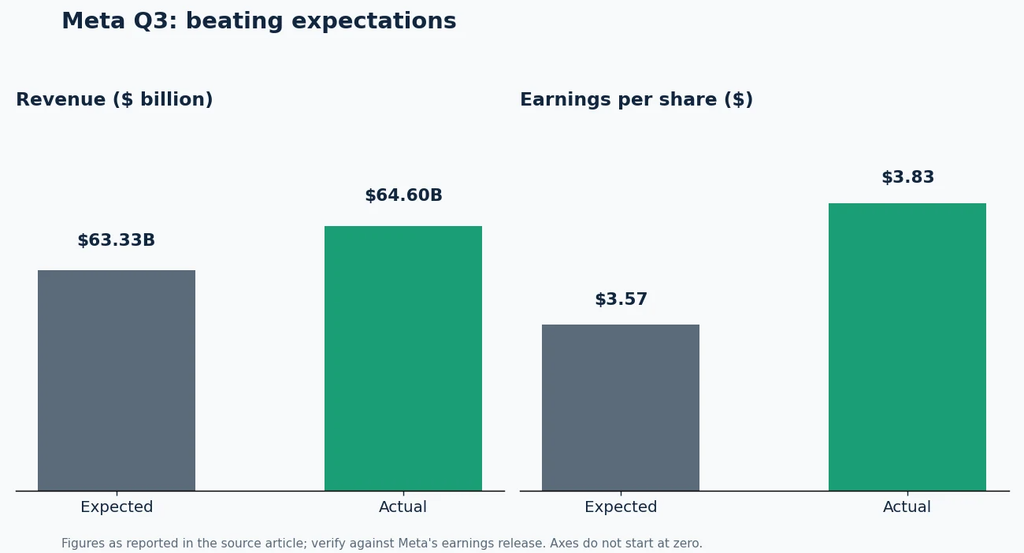
For the third quarter of 2026, Meta reported revenue of $64.60 billion, a 26% increase from the same period a year earlier. Advertising contributed approximately $63.06 billion, making it the company’s dominant revenue source.
The company’s advertising business benefits from its large audience and the ability to help businesses reach potential customers. AI can strengthen this model by improving recommendations, helping advertisers target audiences more effectively and making advertising campaigns more efficient.
However, revenue growth does not tell the entire story.
Meta reported total expenses of $51.61 billion, up 68% year over year. Operating income fell 37% to $12.99 billion, and its operating margin declined from 40% to 20%.
A major factor was a $9.89 billion legal charge related to an agreement with 52 U.S. state attorneys general concerning litigation over teen mental health and social media. Excluding that charge, third-quarter operating income would have been approximately $22.88 billion, while diluted earnings per share would have been $7.40 instead of the reported $3.83.
These adjusted figures help explain the effect of the legal charge, but they are not a replacement for Meta’s reported results.
The takeaway is straightforward: Meta’s core business is growing, but legal expenses and rising operating costs can significantly affect its reported profitability.
The Bet: AI Needs a Very Big Budget
Meta is investing heavily in AI infrastructure, including data centres, computing equipment and the systems required to develop and operate advanced models.
The company expects 2026 capital expenditure—including principal payments on finance leases—to reach $135 billion to $145 billion.
Think of a delivery company buying a large fleet of vehicles. The company pays for the vehicles before they can generate income from future deliveries. Similarly, Meta must spend on computing capacity before it can fully understand the long-term commercial returns from its AI investments.
These investments could help Meta improve its advertising business, develop AI assistants and introduce services for businesses. Meta has said its AI investments are already contributing additional advertising revenue through improved engagement, recommendations and monetisation.
But the opportunity comes with uncertainty. Advanced AI systems are expensive to operate, competitors are investing aggressively, and customers may not adopt every new product at the pace companies expect.
Meta reported negative free cash flow of $2.12 billion for the third quarter. Free cash flow measures the cash remaining after operating activities and capital expenditure, using Meta’s reported definition. A negative figure in one quarter does not automatically signal financial trouble, but it highlights why investors will watch whether future returns justify the spending.
Meta also expects fourth-quarter 2026 revenue of $73 billion to $76 billion. That is company guidance, not a guaranteed outcome.
What Could Go Right—and What Could Go Wrong?
Potential upside
- A large existing user base and growing advertising revenue provide a foundation for AI expansion.
- Better AI-powered advertising tools could improve campaign performance and create additional revenue.
- Class C shares could give Meta greater flexibility in financing, acquisitions and employee compensation without changing existing voting power.
Potential risks
- Infrastructure spending could remain high for longer than expected.
- AI products may take time to generate meaningful revenue.
- Legal and regulatory costs could continue to affect financial results.
- Weak returns on investment could put pressure on profitability and free cash flow.
The Bottom Line
Meta’s new Class C shares are more than a change in how its stock is organised. They are part of a broader strategy to give the company greater flexibility as it competes in an expensive and rapidly evolving AI market.
The company has a strong advertising business, but its rising expenses and substantial infrastructure plans make the next phase financially demanding. The new share structure may help Meta pursue its ambitions, but it does not guarantee that those investments will succeed.
For investors, the central question is not how many shares Meta issues. It is whether the company can turn its AI spending into sustainable revenue, stronger earnings and long-term business value.
Disclaimer: We are neither educators nor financial advisors, and we do not have any professional expertise in the financial world. The articles, insights, and market analysis shared on this website are intended strictly for educational and informational purposes. The content provided does not constitute professional investment advice. Always conduct your own independent research or consult with a licensed financial planner before making any investment decisions.
Sources: Meta Platforms’ third-quarter 2026 earnings announcement and its announcement concerning the proposed Class C share dividend and capital structure