
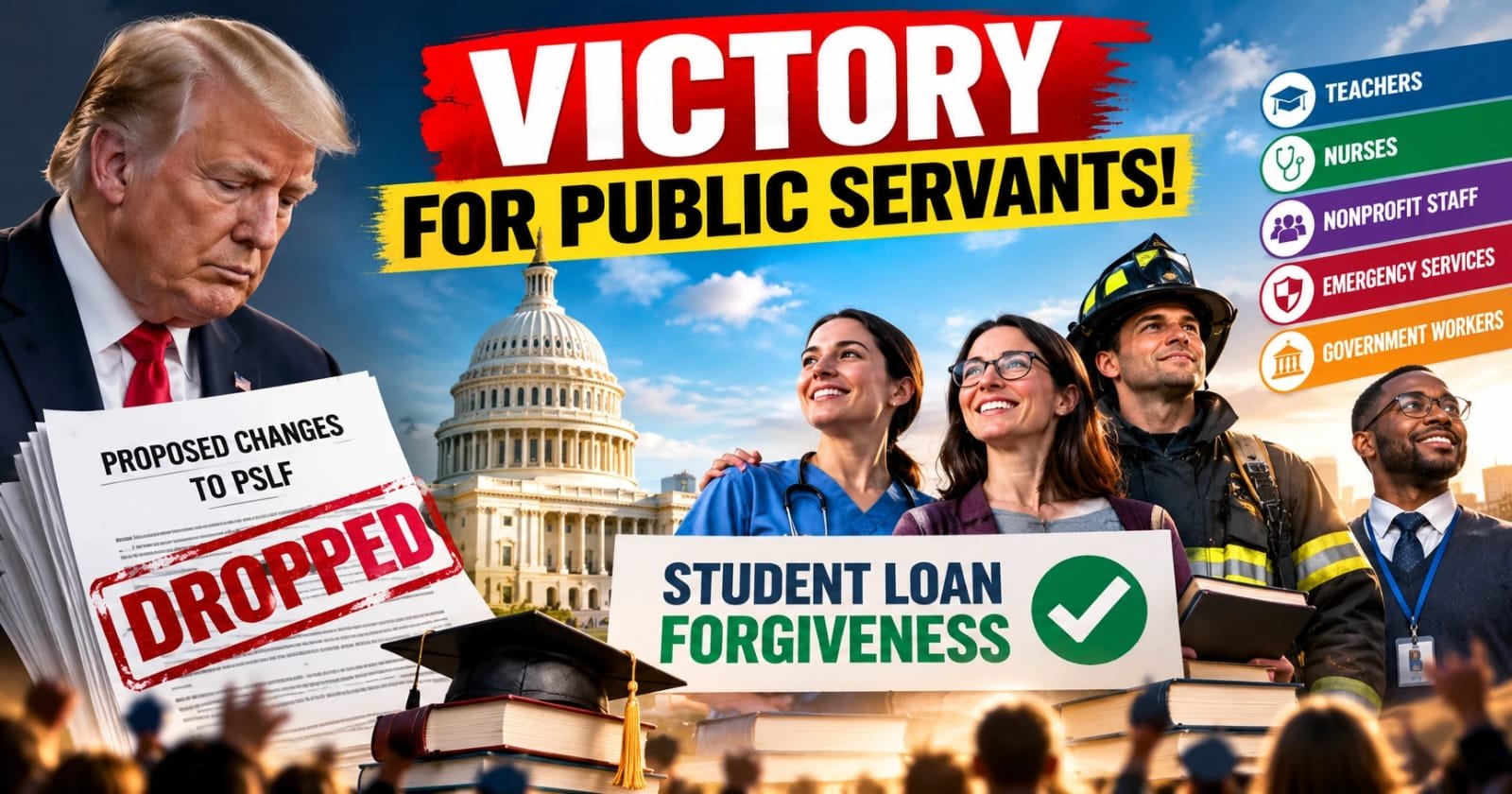
The withdrawal of two appeals preserves court rulings blocking proposed eligibility restrictions, offering greater certainty to public servants pursuing federal student debt relief.
At a glance
- In October 2026, the Trump administration dropped two appeals challenging court rulings that blocked its proposed Public Service Loan Forgiveness (PSLF) restrictions.
- The challenged rule would have allowed the Education Department to disqualify certain government and nonprofit employers based on a finding of a “substantial illegal purpose.”
- PSLF generally forgives eligible borrowers’ remaining federal student loan balances after 120 qualifying monthly payments while working for qualifying employers.
- A separate appeal remained pending in reporting published after the withdrawals, so the broader legal picture was not entirely resolved.
For a teacher working in a public school, a nurse employed by a qualifying nonprofit hospital, or a lawyer providing legal assistance to underserved communities, student debt can influence major life decisions. A public service career may offer meaningful work, but repaying years of education costs can make financial stability difficult.
The Public Service Loan Forgiveness program was created to help address that challenge. In October 2026, a major development in its legal history brought renewed attention to the program: the Trump administration withdrew two appeals seeking to revive restrictions that federal courts had struck down.
The decision preserves important protections against the challenged rule. It also raises a broader question about how government agencies can define eligibility for a public benefit—and how much discretion they have when doing so.
What Is Public Service Loan Forgiveness?
Established by Congress in 2007, PSLF is designed to encourage people to pursue careers in public service.
Under the program, eligible borrowers may qualify to have the remaining balance on their federal Direct Loans forgiven after making 120 qualifying monthly payments while working full-time for an eligible government or nonprofit employer. The payments do not necessarily need to be consecutive, but borrowers must satisfy the applicable program requirements.
Eligible employment can include work for federal, state and local government agencies, public schools and qualifying nonprofit organisations. Certain public health, emergency services and social service roles may also qualify through their employers.
Consider a public school teacher who has federal student loans and spends ten years making qualifying payments while meeting the program’s employment and other requirements. If the teacher completes all the necessary conditions, the remaining eligible loan balance may be forgiven.
The benefit can make public service careers more financially manageable. However, working in a socially valuable role alone does not guarantee eligibility; the borrower’s loans, employment, payment history and other requirements matter.
The Controversial Rule That Triggered the Dispute
The legal conflict centred on a rule finalised by the Education Department in 2025. It would have allowed the department to exclude certain employers from PSLF if officials determined that their activities had a “substantial illegal purpose.”
The administration argued that the restriction was intended to prevent federal benefits from supporting organisations engaged in unlawful conduct.
Critics, however, questioned how the standard would be applied. They argued that its broad language could give government officials considerable discretion to disqualify organisations whose activities were politically controversial, even when those activities were not themselves unlawful.
Examples raised during the dispute included organisations providing legal assistance to immigrants, institutions offering gender-affirming care to minors, and groups involved in certain civil rights or advocacy activities.
The concern extended beyond the organisations themselves. If an employer lost eligibility, employees who had spent years making qualifying loan payments could potentially lose access to a forgiveness pathway because of their workplace’s classification.
That possibility placed public servants at the centre of a dispute over the boundaries of the program.
Why the Courts Rejected the Changes
Nonprofit organisations, local governments and other plaintiffs challenged the rule in federal court. Their arguments focused on the Education Department’s legal authority, the uncertainty surrounding the phrase “substantial illegal purpose,” and the potential consequences for constitutional protections.
In June 2026, two federal judges issued rulings against the challenged restrictions.
U.S. District Judge Myong Joun, in Massachusetts, concluded that the department had exceeded its statutory authority and that the rule was unlawful. In a separate case in Washington, D.C., U.S. District Judge Amir Ali also ruled against the policy.
The challenges involved a broad coalition that included public-interest organisations and cities such as Boston, Chicago and Albuquerque.
The plaintiffs argued that the rule could penalise public employees for their employers’ activities and give officials excessive discretion over access to a benefit established by Congress. The courts’ decisions blocked the rule before it could take effect as scheduled in July 2026.
The administration subsequently appealed the adverse rulings, seeking to continue its legal challenge.
The Decision to Drop the Appeals
In October 2026, the administration withdrew two appeals challenging the court decisions. The Justice Department provided no public explanation for the withdrawals in the reports covering the filings.
The immediate consequence was significant: the rulings blocking the challenged restrictions remained in place in those cases.
Public-interest groups and nonprofit advocates welcomed the move. They said it reduced uncertainty for employees who feared their eligibility might be affected by the work or advocacy of their employers.
However, an important distinction remains. Reporting following the withdrawals indicated that a third appeal, involving a separate case brought by 22 states and Washington, D.C., was still pending. Therefore, it would be premature to describe every related legal proceeding as fully resolved.
Even so, the two withdrawals marked a major development in the effort to defend the existing PSLF framework against the challenged employer restrictions.
What Does This Mean for Borrowers?
For eligible public servants, the immediate takeaway is that the rule blocked by the courts is not being implemented through the withdrawn appeals.
Borrowers should not interpret this development as automatic approval of their loan forgiveness applications. Existing eligibility requirements still matter, including qualifying employment, eligible loans and 120 qualifying monthly payments.
Anyone pursuing PSLF should continue to maintain accurate employment and payment records, check their qualifying payment counts, and use official federal student aid resources for current program guidance.
Employees should also distinguish between an employer’s general nonprofit status and its specific eligibility under PSLF. Not every nonprofit position qualifies automatically, and individual borrowers must meet the applicable requirements.
The decision is best understood as preserving the existing framework against the particular restrictions challenged in court—not as eliminating all student loan rules or guaranteeing forgiveness for every public-sector worker.
What Could Happen Next?
The legal dispute demonstrates how changes to student loan policy can affect workers far beyond the government offices where regulations are written.
For employers, uncertainty about PSLF eligibility can complicate recruitment and retention, particularly in fields where salaries may be lower than comparable private-sector positions.
For employees, the possibility of losing access to forgiveness can influence whether they remain in public service, change employers or reconsider long-term career plans.
The future of the program will depend on the applicable law, court decisions and any further policy actions. The administration could still pursue other lawful approaches to program oversight, but any new restrictions would need to satisfy relevant statutory and constitutional requirements.
The Bottom Line
The withdrawal of two appeals has preserved court rulings blocking a proposed restriction on Public Service Loan Forgiveness. For public servants who have spent years working toward loan forgiveness, the development offers greater certainty that the specific employer-disqualification rule will not take effect through those cases.
Yet the decision does not eliminate PSLF’s existing eligibility requirements, guarantee forgiveness for every borrower or establish that every related legal proceeding has ended.
The larger lesson is that student loan relief is not simply a question of debt and repayment. It also affects the people who teach children, provide public health services, support vulnerable communities and keep government institutions operating.
For borrowers, the practical priority remains clear: understand the program’s current requirements, document qualifying employment and payments, and follow official updates as the remaining legal questions develop.
This article is for general informational purposes only and is not legal or financial advice.
Sources: Associated Press reporting on the withdrawn appeals; Public Citizen’s October 2026 announcement; and statements from state attorneys general involved in the litigation.