
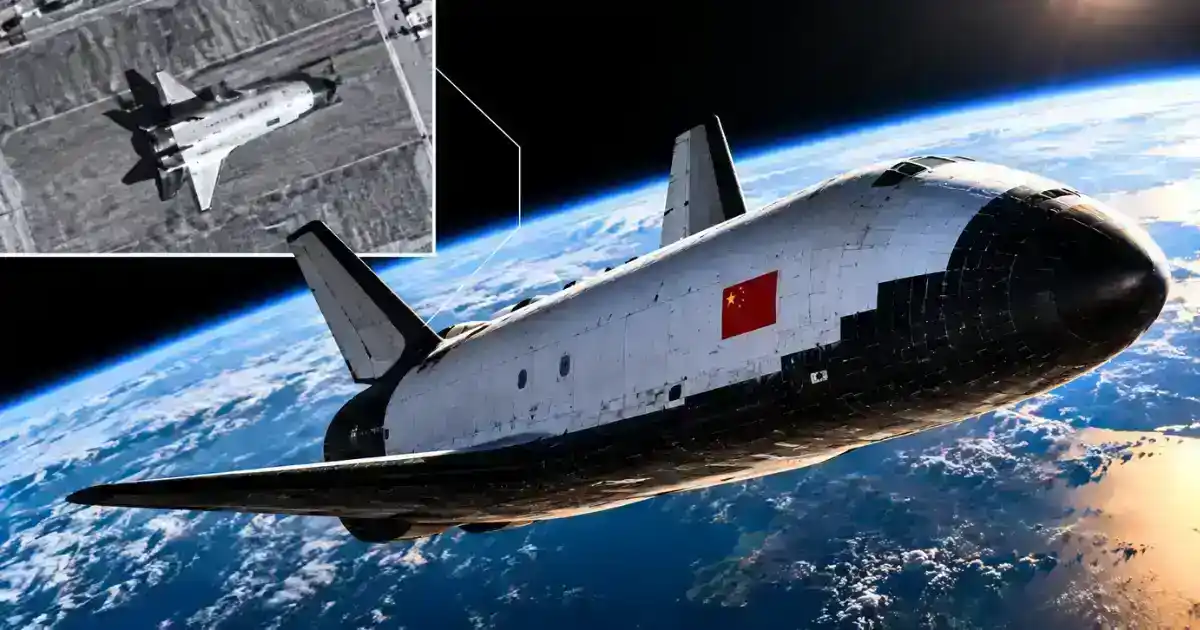
A newly released U.S. intelligence image shows a Chinese spaceplane apparently connected to another spacecraft, highlighting the growing role of commercial satellites in monitoring secretive military space programs.
Key Takeaways
- Rare image released: On October 26, 2026, the U.S. Defence Intelligence Agency (DIA) published a high-resolution image of a Chinese spaceplane in its latest Challenges to Security in Space report.
- A commercial satellite captured it: Vantor, formerly known as Maxar Technologies, took the photograph in May 2024 using its WorldView-3 satellite from approximately 90 kilometres away.
- Another spacecraft is visible: The image shows what appears to be a spacecraft attached to the vehicle’s rear, with solar arrays deployed and the spaceplane’s payload bay doors open.
- Its mission remains uncertain: The photograph offers valuable clues about China’s space capabilities, but it does not establish the purpose of the apparent connection or prove that the vehicle is being used as a weapon.
- Commercial intelligence is changing the picture: Private companies can now collect detailed imagery of objects in orbit, giving governments and analysts new ways to examine space activities that were previously difficult to observe.
A Rare Look at China’s Secretive Spaceplane
For years, China’s experimental reusable spaceplane has operated largely out of public view. The vehicle is widely known in international reporting as Shenlong, meaning “Divine Dragon,” although the latest U.S. intelligence report does not definitively identify the photographed spacecraft by that name.
That secrecy has now been pierced by an unusually detailed image.
Released by the U.S. Defence Intelligence Agency, the photograph shows a winged spacecraft resembling a miniature space shuttle. Its visible features include a dark heat-shield area, small wings, an open payload bay and a structure at the rear with deployed solar arrays.
The image was captured by Vantor’s WorldView-3 commercial imaging satellite in May 2024. Although the photograph was taken more than two years before its public release, it provides one of the clearest views yet of China’s secretive spaceplane.
The significance extends beyond the photograph itself. It demonstrates how commercial imaging technology can help reveal details about spacecraft whose designs and missions are not routinely disclosed.
Read the report: U.S. Defense Intelligence Agency
What Is a Spaceplane, and Why Does It Matter?
A spaceplane combines characteristics of a spacecraft and an aircraft. Unlike a conventional satellite, which generally remains in orbit until its mission ends or its orbit changes, a reusable spaceplane is designed to return to Earth and fly again.
The basic process works like this:
- Launch: A rocket carries the spaceplane beyond Earth’s atmosphere and into orbit.
- Orbital operations: The uncrewed vehicle can remain in space for extended periods, carrying equipment, conducting experiments or performing other mission tasks.
- Return: At the end of its mission, it re-enters Earth’s atmosphere and lands autonomously on a runway.
- Reuse: After inspection and refurbishment, it may be prepared for another flight.
The ability to return to Earth and fly again offers potential advantages over spacecraft designed for a single mission. It can also give operators more flexibility over the timing and nature of their activities in orbit.
China is not alone in pursuing this technology. The United States operates the X-37B, a reusable, uncrewed spaceplane used by the U.S. Space Force. Both programs are highly secretive, and much of their operational work remains undisclosed.
China has described its reusable spacecraft program in peaceful terms, but the limited public information about its activities has encouraged other countries to examine its capabilities closely.
The Most Intriguing Detail: Another Spacecraft at the Rear
The most striking feature of the newly released photograph is not simply the shape of the spaceplane. It is the object that appears to be attached to its rear.
The second spacecraft has solar arrays extended, while the spaceplane’s payload bay doors appear to be open. The photograph does not identify the other object or explain why the two vehicles were connected.
Nevertheless, the image raises important questions about the spacecraft’s ability to operate near other objects in orbit.
What are proximity operations?
In spaceflight, rendezvous and proximity operations involve spacecraft changing their trajectories to approach, observe or operate near another object. Depending on the vehicle’s design, such operations can support activities such as inspection, docking, satellite servicing or the deployment and retrieval of smaller spacecraft.
These capabilities can have legitimate civilian applications. For example, future servicing vehicles could potentially help extend satellite lifespans by repairing equipment, refuelling compatible spacecraft or removing defunct objects from orbit.
However, similar capabilities can also raise security concerns. A spacecraft able to approach another satellite could potentially inspect its design and condition. Depending on its equipment and the circumstances, it might also interfere with or damage another vehicle.
The important distinction is that the photograph does not prove all these capabilities. It provides evidence of an apparent connection between two spacecraft, but it does not reveal the identity of the second object, the purpose of the operation or whether the vehicle can carry out hostile actions.
The broader concern comes from the dual-use nature of space technology: equipment developed for maintenance or inspection may also have military applications.
Commercial Satellites Are Changing Space Intelligence
The photograph also illustrates a major shift in intelligence gathering.
Traditionally, much of the public’s understanding of secretive spacecraft came from ground-based telescopes, orbital tracking data, official statements and occasional military disclosures. These methods remain important, but commercial satellites have created another avenue for observation.
Vantor’s WorldView-3 is designed primarily for high-resolution Earth imaging. Yet, under suitable conditions, an Earth-observation satellite can also point its instruments towards an object in space.
This technique, often called non-Earth imaging, can provide a closer look at spacecraft that are otherwise difficult to examine.
The implications are significant:
- More independent observation: Governments, researchers and analysts can gain information from commercial imagery rather than relying entirely on official disclosures.
- Greater visibility into secret programs: Detailed images may reveal spacecraft shapes, exposed components and apparent interactions with other objects.
- More scrutiny of military activity: Countries may find it harder to keep every aspect of their space operations hidden from outside observers.
- A growing commercial intelligence market: Private satellite operators are becoming an increasingly important source of information for governments and security analysts.
However, commercial imaging has limitations. A photograph captures a particular moment, not an entire mission. It may reveal a spacecraft’s appearance without explaining its orders, purpose or technical capabilities.
The image is therefore a valuable piece of evidence, but not a complete account of China’s space program.
The U.S.–China Space Race Is About More Than Exploration
Space has become essential to modern economies and national security.
Satellite networks support navigation, communications, weather forecasting, financial timing systems, military coordination and intelligence gathering. Disruptions to important satellites could affect both civilian services and defence operations.
That dependence has made the protection of space infrastructure a growing priority for major powers.
The DIA’s latest report examines threats to space systems and the development of technologies that could interfere with satellites. It also discusses China’s progress in areas such as directed-energy systems and other counterspace capabilities.
According to the assessment, China already has ground-based laser systems capable of disrupting, degrading or damaging satellites in low Earth orbit. The agency also assesses that China could develop more advanced space-based directed-energy systems later this decade. Such projections are assessments, not confirmation that every proposed capability is already operational.
The United States is developing and operating its own advanced space technologies, including the X-37B and systems designed to monitor activity in orbit. Russia is also pursuing capabilities that could threaten satellites.
This creates a complicated security environment. Technologies that improve the ability to inspect, manoeuvre around or service spacecraft can also raise concerns about surveillance and interference.
The challenge for governments is to protect critical space infrastructure without allowing competition to make orbit increasingly unstable.
Could the Technology Have Peaceful Uses?
Yes. The same general capabilities that make a spacecraft useful for military missions may also support practical civilian services.
In the future, spacecraft equipped for close-proximity operations could help repair satellites, transfer propellant, inspect damaged equipment or remove dangerous debris. These services could reduce the need to replace expensive satellites and help make space activities more sustainable.
Reusable spaceplanes may also provide a platform for testing technologies that need to operate in orbit before being returned to Earth for examination.
But these possibilities should not be confused with confirmed activities. The newly released image does not establish that the Chinese vehicle was refuelling, repairing or cleaning up another spacecraft. Nor does it prove that the apparent connection was part of a weapons test.
Understanding the mission will require more evidence, including additional observations, credible analysis of orbital movements and any future disclosures from Chinese or U.S. authorities.
What Happens Next?
For space agencies, defence officials and commercial satellite operators, the image raises several questions worth watching.
First, what was the second spacecraft? Identifying the object and understanding its relationship to the spaceplane could help clarify the purpose of the operation.
Second, how frequently can the vehicle perform close-proximity manoeuvres? Repeated observations could provide better evidence of its operational capabilities than a single photograph.
Third, how will commercial intelligence develop? As more companies invest in satellite imaging and orbital observation, the public may gain further insight into space activity that was once difficult to monitor.
Finally, the United States and China face a wider challenge: establishing how to manage growing military competition in an environment where satellites are vital to both civilian life and national security.
More visibility could help analysts understand potential threats. It could also intensify strategic rivalry if every manoeuvre is interpreted as a hostile act.
The Bottom Line
The newly released photograph offers a rare and valuable look at China’s secretive reusable spaceplane. Taken by a commercial satellite in 2024 and made public through a U.S. intelligence report in October 2026, it shows a winged spacecraft with its payload bay open and another object apparently attached at the rear.
The image reinforces the growing importance of commercial satellite technology in understanding activity beyond Earth. It also highlights the dual-use nature of advanced space capabilities: the ability to approach and interact with another spacecraft may support maintenance and scientific work, but it can also create security risks.
For now, the precise identity of the photographed vehicle and the purpose of the apparent connection remain incompletely established. The photograph is an important clue—not definitive proof of a particular military mission.
As the space race evolves, the ability to observe what happens in orbit may become nearly as important as the ability to operate there.
Disclaimer
This article is for informational and educational purposes only. It discusses publicly reported space technology and security assessments. Intelligence assessments may contain uncertainty, and the capabilities or intentions of individual spacecraft should not be treated as confirmed unless supported by reliable evidence.