
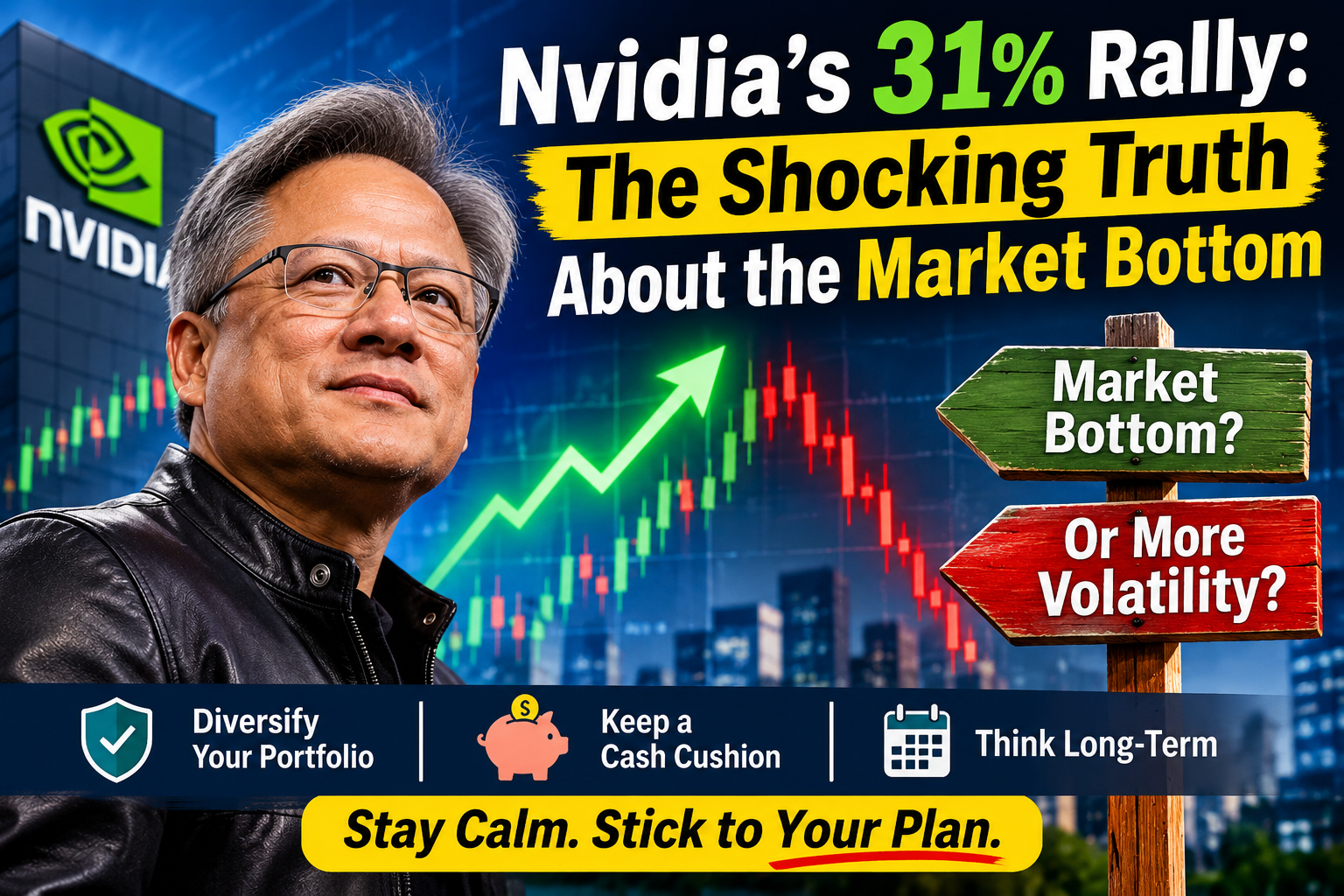
A sharp market decline can make investors anxious. But sometimes, what follows can be even more confusing.
Between November 20 and November 25, 2026, global financial markets experienced a dramatic sequence of selling, a powerful rebound and another wave of uncertainty. After major US stock indexes entered correction territory, Wall Street staged a historic rally on Monday, November 23, led by a stunning jump in Nvidia shares.
The S&P 500 rose approximately 4.7%, while the Nasdaq Composite gained around 6.5%. Nvidia surged nearly 31% after reports that its board had reinstated co-founder Jensen Huang as president, chief executive officer and director.
For a moment, it appeared that the market might have found its footing.
But the optimism did not last long. On Tuesday, November 24, the S&P 500 slipped about 0.5%, the Nasdaq fell approximately 1.5%, and Nvidia gave back nearly 5.9% of its Monday gains. By Wednesday morning, futures were pointing lower again as investors continued to question AI valuations, interest rates and the enormous spending required to build artificial intelligence infrastructure.
The sequence raises a familiar question for investors: Was Monday’s rally the beginning of a lasting recovery, or simply a temporary bounce after a painful sell-off?
The answer is difficult to know in real time. And that uncertainty leads to a more useful question: if nobody can reliably identify the exact market bottom, what should investors focus on instead?
At a Glance
- US stocks entered correction territory during the November 20 sell-off.
- Nvidia reportedly surged around 31% on November 23, helping lift the S&P 500 by approximately 4.7%.
- The Nasdaq Composite gained roughly 6.5% on Monday, its strongest daily rise since April 2025, according to the supplied reports.
- The rally weakened on November 24, with Nvidia falling nearly 5.9%.
- Investors continued to worry about AI infrastructure spending, valuations, inflation and interest rates.
- The key lesson is that a dramatic rebound does not confirm a market bottom. A resilient investment plan matters more than perfect market timing.
1. What Triggered Wall Street’s Dramatic Rally?
The week began with investors still dealing with the consequences of a sharp decline in technology and semiconductor stocks.
On Friday, November 20, the S&P 500 and Dow Jones Industrial Average closed in correction territory, meaning they were at least 10% below their recent record highs. The Nasdaq had also suffered a steep decline as concerns about AI-related valuations spread across the market.
Then came Monday’s unexpected turnaround.
According to the Yahoo Finance report you shared, Nvidia’s board reinstated Jensen Huang as president, CEO and director. The decision reportedly followed a period of uncertainty surrounding the company’s leadership.
Investors reacted strongly because Huang is closely associated with Nvidia’s AI strategy, product development and relationships with major technology customers.
For many market participants, the leadership news appeared to reduce a major source of uncertainty around one of the world’s most influential semiconductor companies.
Monday’s market movement
| Market or stock | November 23 movement |
|---|---|
| S&P 500 | Approximately +4.7% |
| Nasdaq Composite | Approximately +6.5% |
| Dow Jones Industrial Average | Approximately +3.0% |
| Nvidia | Approximately +31% |
The rally was remarkable not only because of its size, but also because it followed a period of intense selling.
When investors become heavily pessimistic, even a single positive development can trigger a powerful recovery. Traders who had bet on further declines may close their positions, while investors who believe prices have fallen too far may begin buying.
This combination can push prices higher very quickly.
However, the rally also had a major limitation: it was heavily influenced by a single company and a single corporate event.
That does not make the rebound meaningless. It does mean investors should be careful about interpreting it as proof that the broader market’s problems have disappeared.
2. Why Nvidia’s Rally Did Not Automatically Confirm a Market Bottom
A market bottom is the point at which prices stop falling and begin a sustained recovery.
The difficulty is that nobody knows in real time whether a particular low will hold.
A market can fall sharply, rebound for several sessions and then decline again. It can also recover quickly and never revisit its previous low.
The November 23 rally illustrates this uncertainty.
Nvidia reportedly rose around 31% in one session. The S&P 500 gained approximately 4.7%. Those are extraordinary moves, but they came after a substantial decline.
A large rebound can recover only part of the losses that preceded it.
A simple example
Imagine an investment that falls from $100 to $80.
That is a 20% decline.
If it then rises 20%, its value becomes $96—not $100.
Why? Because the percentage gain is calculated from the lower price.
| Price movement | Value |
|---|---|
| Starting value | $100 |
| After a 20% decline | $80 |
| After a 20% rebound | $96 |
This is why investors should not assume that a large percentage gain has erased the damage caused by a previous decline.
The same principle applies to broad market indexes. A powerful one-day rally may improve sentiment, but it does not necessarily restore the market to its previous high or resolve the concerns that caused the sell-off.
The importance of market breadth
Another useful factor is market breadth.
Market breadth refers to how widely a market movement is shared across stocks and sectors.
If a rally is driven mainly by a handful of large technology companies, it may be less convincing than a recovery in which many sectors and companies participate.
Nvidia’s enormous market influence means that a sharp move in its shares can affect major indexes significantly.
That is why investors should look beyond the headline index gain and ask:
- Did financial stocks participate?
- Did industrial and consumer companies recover?
- Were smaller companies also moving higher?
- Did the rally continue over several sessions?
- Were trading gains supported by improving business fundamentals?
A broad and sustained recovery would provide more evidence of improving market conditions than one exceptional trading session.
3. Why the Rally Faded on Tuesday
The market’s reaction on November 24 showed that investors were not ready to forget the concerns that had contributed to the earlier decline.
According to the supplied reports, the S&P 500 fell approximately 0.5%, while the Nasdaq declined around 1.48%.
Nvidia also gave back nearly 5.9% after its extraordinary Monday surge.
The reversal was not necessarily a sign that the rally had been meaningless. After such a large move, some investors may have chosen to take profits. Others may have been unwilling to hold positions while uncertainty remained high.
But the decline demonstrated that the market was still sensitive to several unresolved issues.
AI spending and the question of returns
Technology companies are investing enormous amounts of money in AI infrastructure.
That includes data centres, advanced chips, networking equipment, electricity infrastructure and computing capacity.
The investment may create significant opportunities. However, investors are increasingly asking whether the revenue and profits generated by AI will justify the cost.
Building infrastructure is only one part of the equation.
Companies must eventually demonstrate that customers are willing to pay enough for AI products and services to support the investment.
If spending continues to rise faster than expected revenue, investors may become less willing to pay premium valuations for technology stocks.
Interest rates and inflation
Interest rates also influence how investors value stocks.
When bond yields rise, safer investments may become more attractive relative to equities. Higher borrowing costs can also make it more expensive for companies to finance expansion.
Technology stocks are particularly sensitive to changes in interest-rate expectations because a significant portion of their valuation may depend on profits expected years into the future.
If inflation remains persistent or the Federal Reserve signals that rates may stay higher for longer, investors may reassess how much they are willing to pay for future growth.
This does not mean every market decline is caused by interest rates. It means monetary policy remains one of several factors that can influence market sentiment.
4. Why Nobody Can Reliably Call the Bottom
Investors naturally want certainty during a market correction.
They want to know whether the lowest price has already occurred, whether they should buy now or whether waiting could lead to a better opportunity.
Unfortunately, market bottoms are visible with confidence only after the fact.
The November 20–25 sequence shows how quickly the situation can change:
- November 20: Major US indexes entered correction territory amid heavy selling.
- November 23: Nvidia surged, and Wall Street staged a powerful rebound.
- November 24: The rally weakened as technology stocks fell again.
- November 25: Investors continued to assess whether the recovery could hold.
A single positive headline can change sentiment quickly. But it cannot guarantee that earnings will improve, inflation will decline,e or AI spending will produce the returns investors expect.
Market history also shows that corrections are a normal part of investing. They can occur during periods of economic growth, and they do not always lead to recessions.
At the same time, some corrections develop into deeper bear markets. The outcome depends on factors such as corporate earnings, economic conditions, credit availability and investor expectations.
The practical lesson is not that investors should ignore market declines. It is that they should avoid making their entire investment strategy dependent on predicting the exact day prices will stop falling.
5. What Investors Can Do Instead of Chasing the Bottom
The Motley Fool report you shared shifts the discussion from market prediction to financial preparation.
That is a useful change in perspective.
Rather than asking whether Monday was the perfect buying opportunity, investors can ask whether their financial plan is strong enough to handle another decline.
A resilient plan generally includes several elements.
Keep an emergency fund
An emergency fund helps cover unexpected expenses without forcing you to sell investments during a market downturn.
For households, this money should be kept in relatively accessible and low-risk places rather than invested in volatile stocks.
The appropriate amount depends on income stability, family responsibilities and regular expenses.
Diversify your investments
Holding too much money in one company, one sector or one investment theme can make a portfolio vulnerable to sudden changes in sentiment.
Nvidia may be an important company in the AI ecosystem, but even a successful business can experience significant share-price volatility.
Diversification across companies, sectors and asset classes can help reduce the impact of a single investment’s decline.
It does not eliminate market risk, but it can prevent one company from determining the entire outcome of your portfolio.
Think in years rather than days
Long-term investing is built around the growth of businesses and the compounding of returns over time.
A daily market movement may be important to traders, but it usually tells a long-term investor very little about whether a diversified portfolio is appropriate for a five- or ten-year goal.
That does not mean investors should ignore changes in business fundamentals. If a company’s competitive position or financial health deteriorates, reassessment may be necessary.
The point is to distinguish between temporary market volatility and a meaningful change in the underlying investment.
Expect volatility before it arrives
Investors often underestimate how uncomfortable a market decline can feel.
A portfolio that looks acceptable during a rising market may become difficult to hold when it loses 20% or more.
Before investing, consider how much volatility you can realistically tolerate without abandoning your strategy.
A plan that looks excellent on paper but causes panic during every correction may not be suitable for your circumstances.
6. Is Gradual Investing Better During a Market Correction?
One approach discussed in the supplied report is dollar-cost averaging.
Dollar-cost averaging means investing a fixed amount at regular intervals rather than investing all available money at once.
For example, an investor with ₹1,20,000 set aside for long-term investment might choose to invest ₹10,000 each month over 12 months.
This approach has a few practical advantages.
If prices decline after the first investment, later contributions purchase more units at lower prices. If prices rise, the investor already has some money invested and participates in the recovery.
However, dollar-cost averaging does not guarantee profits or prevent losses.
If markets rise steadily, investing a lump sum earlier may produce a higher return than spreading the investment over time. The choice depends on the investor’s circumstances, risk tolerance and financial goals.
For investors who feel uncomfortable making a large investment during uncertain conditions, gradual investing can provide a structured alternative to trying to identify the perfect entry point.
The most important point is to follow a consistent plan rather than changing the schedule every time the market moves.
Key Takeaways
- Nvidia’s reported 31% rally helped drive a historic rebound in US stocks on November 23.
- The S&P 500 gained approximately 4.7%, while the Nasdaq Composite rose around 6.5%.
- The market weakened again on November 24, showing that the rally had not resolved concerns about AI spending, valuations and interest rates.
- A sharp rebound does not confirm a market bottom. The recovery needs to be assessed over time.
- Market breadth, earnings and economic conditions provide more useful evidence than one exceptional trading session.
- Emergency savings, diversification and a long-term investment horizon can help investors manage volatility.
- Gradual investing may reduce the pressure to make one perfect timing decision, but it does not guarantee better returns.
- Indian investors should assess their actual exposure to global technology stocks while remembering that domestic markets have their own drivers.
The Bottom Line
The market’s sharp reversal between November 20 and November 25 is a reminder of how quickly financial sentiment can change.
A steep sell-off can be followed by an extraordinary rally. That rally can then lose momentum before investors have time to decide whether the worst is over.
Nobody knows with certainty whether the recent lows will hold or whether markets will test lower levels again.
But investors do not need to predict every turn to build long-term wealth.
A strong financial plan starts with money set aside for emergencies, a diversified portfolio, realistic expectations about volatility and a clear understanding of when the money will be needed.
The goal is not to buy at the exact bottom or sell at the exact top.
The goal is to build a financial plan that remains workable even when the market does not behave the way you expected.
Disclaimer: This article is for informational and educational purposes only and does not constitute financial or investment advice. Stock markets and individual securities can be volatile, and investors may lose some or all of their invested capital. Past market performance does not guarantee future results. Investment decisions should be based on individual financial goals, risk tolerance and time horizon.