
Cryptocurrency gives people more direct control over their money. A digital wallet can hold assets worth thousands of dollars, and you can transact without visiting a bank or waiting on traditional payment systems. But that convenience comes with a responsibility: protecting those assets often depends on the security of your devices, your passwords and the decisions you make online.
That responsibility is becoming more difficult as cybercriminals adopt increasingly sophisticated methods. Some scams rely on fake websites and convincing messages. Others use artificial intelligence to imitate real people, create believable videos or make fraudulent investment opportunities appear legitimate. At the same time, software vulnerabilities can put sensitive information at risk even when users believe they are following safe practices.
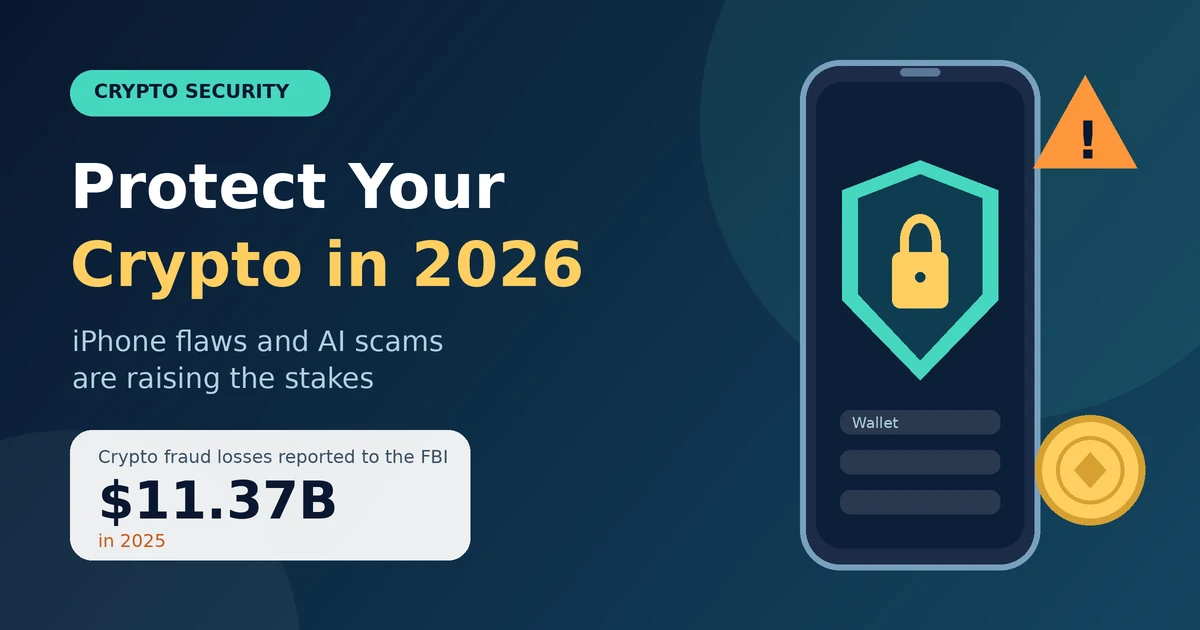
Recent developments have brought these concerns into sharper focus. The FBI’s 2025 Internet Crime Report recorded more than $11.3 billion in reported losses associated with cryptocurrency complaints. Separately, a recently disclosed iOS security vulnerability raised concerns that malicious applications could access files belonging to other apps, potentially exposing cryptocurrency recovery phrases and private keys.
For crypto investors, these developments point to an important lesson: keeping digital assets safe requires more than choosing a well-known exchange or wallet. It requires device security, careful online behaviour, and sensible transaction controls.
Key Takeaways
- The losses are huge. The FBI’s 2025 Internet Crime Report counts 181,565 crypto complaints and about $11.37 billion in reported losses, up 22% from the year before.
- The average hit is painful. The average loss was about $62,604, and nearly 18,600 people reported losing more than $100,000.
- AI is a growing factor. The FBI recorded 22,364 AI-related complaints and nearly $893 million in losses, but those figures overlap with the crypto numbers.
- A new iPhone exploit is in the news. The “worse_query” sandbox escape could let a malicious app read other apps’ data, but no confirmed crypto thefts have been reported in the coverage I found.
- A few habits block most of the risk. Address allowlists, bookmarked sites, offline recovery phrases and a refusal to act under pressure.
The Growing Financial Cost of Cryptocurrency Fraud
The scale of cryptocurrency-related fraud is no longer a concern limited to a small group of digital asset investors. The FBI’s Internet Crime Complaint Centre (IC3) received 181,565 complaints involving cryptocurrency in 2025. The reported losses reached approximately $11.37 billion, representing a 22% increase from the previous year.
The figures are significant for another reason. The average reported loss per cryptocurrency complaint was approximately $62,604. Nearly 18,600 complainants reported losing more than $100,000.
These numbers do not mean every cryptocurrency user faces the same level of risk. They do, however, show how financially damaging these schemes can become when people are persuaded to transfer money, reveal sensitive information or give criminals access to their accounts.
Artificial intelligence is adding another dimension to the problem. The FBI recorded 22,364 AI-related complaints involving nearly $893 million in reported losses during 2025. The agency described tactics that included fake social media profiles, cloned voices, fraudulent identification documents and realistic videos featuring public figures or people familiar to victims.
It is important not to combine the cryptocurrency and AI figures as though they represent two completely separate groups of victims. A single complaint can involve cryptocurrency, AI or both. The figures are useful indicators of the scale of the problem, but they do not establish that every cryptocurrency fraud involved artificial intelligence.
For investors, the broader message is clear: criminals are using both traditional deception and newer technology to make fraudulent activity more believable.
Why an iOS Security Vulnerability Matters to Crypto Investors
A recent warning involving Apple’s mobile operating system has brought attention to a different kind of risk: the possibility that a malicious application could access information stored by other apps.
The issue, reported in November 2026, involves a technique known as worse_query. It has been described as an iOS sandbox escape. To understand why this matters, it helps to know how smartphone security normally works.
Mobile applications are designed to operate within separate, restricted environments. This arrangement is commonly called sandboxing. In simple terms, an application should not be able to freely browse the private files of another application. A wallet app, for example, should keep its stored information separate from unrelated software installed on the same phone.
The reported vulnerability raises concerns that this separation can be bypassed under certain conditions. Security reporting has described a proof-of-concept tool that can access data belonging to other applications on affected iPhones without requiring the device to be jailbroken.
For cryptocurrency users, the concern is particularly serious because wallets may store sensitive information locally. This can include recovery phrases, private keys, account credentials or other data that could help someone gain control of digital assets.
A recovery phrase, sometimes called a seed phrase, is a sequence of words used to restore access to a cryptocurrency wallet. A private key is a cryptographic credential that authorises control over funds. If someone obtains these details, they may be able to take control of the associated wallet.
However, there are important qualifications. The reported exploit does not automatically empty a wallet simply because an iPhone is running a particular version of iOS. A malicious application would need to be installed and run, and the exposure of sensitive information depends on how that information is stored and whether it can be accessed.
Binance warned users about the issue and identified iOS versions 26.7.1, 27.0.1 and 27.2 among those affected by its warning. The Hacker News reported that Apple security updates released on November 9 did not explicitly confirm a fix for worse_query. As of November 14, reports had not identified confirmed cryptocurrency thefts caused by this specific exploit.
This does not mean users should ignore the warning. It means they should respond carefully rather than assume either that every device has been compromised or that installing an update has necessarily resolved every aspect of the issue.
Users should install the latest security updates available for their devices, remove applications they do not recognise or trust, and avoid installing software from unofficial sources. Anyone who suspects that sensitive wallet information may have been exposed should consider moving funds to a new wallet created on a clean, trusted device and resetting relevant account sessions. For substantial holdings, it may also be sensible to seek guidance from the wallet provider’s official security team.
Four Practical Ways to Protect Your Cryptocurrency
Technical vulnerabilities are only one part of the problem. Many cryptocurrency losses still begin with a message, a fake website or a transaction that a victim is persuaded to approve.
The following precautions can help reduce the chances of falling into common traps.
1. Use Wallet Address Allowlists
One useful security feature offered by some cryptocurrency exchanges and platforms is an address allowlist, also known as a whitelist.
Think of it as an approved-recipient list for your money. You add wallet addresses that you trust and expect to use. When the feature is enabled, withdrawals can be restricted to those previously approved destinations.
This can provide an additional layer of protection if someone gains access to your exchange account. Even if a criminal obtains your password, they may not be able to withdraw funds to a completely new address immediately.
Some platforms also offer a withdrawal address lock or a waiting period before a newly added address becomes eligible for transfers. These features can create valuable time to identify suspicious activity and stop a transfer before it takes place.
There are limitations. An allowlist does not protect against every type of fraud. If you approve a scammer’s address yourself, the platform may treat it as an authorised destination. It also does not protect a self-custody wallet from someone who has already obtained its private key or recovery phrase.
Before making a transfer, check the complete destination address carefully. Do not assume that an address is safe simply because its name looks familiar. Where possible, use the platform’s security settings to restrict withdrawals and enable additional verification.
2. Avoid Sponsored Search Results for Crypto Services
Search engines are often the first place people go when looking for a cryptocurrency exchange, wallet provider or decentralised finance platform. Unfortunately, the most visible result is not always the safest one.
Criminals can purchase sponsored advertising placements that imitate legitimate companies. These advertisements may use familiar brand names, logos and website designs. A fraudulent page can look convincing enough to fool someone who is in a hurry.
The danger begins when a user enters login credentials, connects a wallet or signs a transaction on a fake website. Depending on the scam, this could expose account information or give an attacker permission to move assets.
A safer approach is to avoid relying on sponsored advertisements when accessing financial services. Type the official website address yourself or use a bookmark that you created after independently checking the address.
If you receive a link through email, a text message or social media, do not assume it is genuine just because it contains a familiar company name. Check the domain carefully. Fraudulent websites sometimes use small spelling changes, extra characters or unfamiliar extensions to resemble legitimate addresses.
It is also worth remembering that a website’s professional appearance proves very little. A convincing design is easy to copy. The address and the authenticity of the service matter far more.
3. Treat Unsolicited Direct Messages With Suspicion
Not every cryptocurrency scam begins with a suspicious website. Some start with an apparently friendly conversation.
A stranger may contact someone through a social media platform, messaging app or online investment community. The conversation might initially have nothing to do with cryptocurrency. The person may discuss hobbies, work, financial goals or market trends before gradually introducing an investment opportunity.
This approach can be more effective than an obvious scam message because it gives the criminal time to build trust. After establishing a connection, the person may recommend a trading platform, offer to share an investment strategy or suggest downloading a special application.
The software may be malicious, or the recommended platform may simply be a fake service designed to collect deposits. In other cases, the scammer may ask the victim to move the conversation to another messaging platform, where it becomes harder to report or moderate suspicious behaviour.
The safest response is to avoid installing applications or opening files recommended by strangers. Do not share recovery phrases, private keys, passwords or one-time verification codes with anyone. A person claiming to be a wallet representative or exchange employee should never need your recovery phrase to solve a routine account problem.
Be especially cautious when someone promises unusually high returns, claims to have access to exclusive trading information or offers to manage your cryptocurrency for you.
A genuine opportunity should withstand independent research. If someone insists that you must trust them before you can verify the details, that is a reason to walk away.
4. Do Not Let Urgency Make Decisions for You
Scammers understand that people make poorer decisions when they are frightened, excited or under pressure. That is why many fraudulent messages are designed to create a sense of urgency.
You might receive an alert claiming that your wallet has been compromised. Another message may say that a withdrawal is pending and must be cancelled immediately. A supposed support representative could warn that your account will be frozen unless you follow a set of instructions.
Investment scams use a different version of the same tactic. They may tell you that a special opportunity is available for only a few hours or that you must transfer money immediately to secure a place.
The purpose is to prevent you from checking the facts.
When a message demands immediate action, pause before doing anything. Do not click the link or call the number provided in the message. Instead, open the service through its official website or application and contact its support team using independently verified details.
Never share a recovery phrase or private key because someone claims it is necessary to protect your account. Legitimate security procedures should not require you to disclose those credentials to another person.
A short delay can make a significant difference. If the situation is genuine, you should be able to verify it through an official channel. If the person contacting you becomes more aggressive when you ask for time, treat that behaviour as a warning sign.
How Artificial Intelligence Could Make Crypto Scams More Convincing
Artificial intelligence is changing the way fraudsters communicate with potential victims. Tools that can generate realistic text, images, audio and video make it easier to create convincing identities and messages.
A scammer no longer needs to rely only on poorly written emails or generic investment pitches. AI tools can help produce messages that sound natural, imitate a company’s communication style or appear tailored to a particular individual.
Voice cloning presents an additional challenge. A criminal may use publicly available recordings to create audio that resembles a family member, colleague or business contact. A victim could receive a call that sounds familiar and includes an urgent request for money or sensitive information.
Deepfake videos can make the deception more persuasive. Fraudsters may use fabricated recordings of public figures or financial personalities to promote fake investment schemes. The presence of a familiar face should never be treated as proof that an offer is genuine.
The next stage could involve more autonomous AI systems that handle conversations in real time. Such tools may be able to respond to questions, adjust their language and maintain a conversation without constant human involvement. This could make fraudulent interactions more scalable and harder to identify through simple spelling or grammar checks.
However, it is important to distinguish between a developing risk and a confirmed prediction. Not every scam uses advanced AI, and not every AI-generated interaction is fraudulent. The practical lesson is to verify financial instructions through a second, independent channel, especially when they involve transfers, account access or changes to payment details.
For example, if someone claiming to be a relative calls and asks for an urgent cryptocurrency transfer, end the call and contact that person using a number you already know. Do not rely on the incoming caller ID or a voice that merely sounds familiar.
A Stronger Crypto Security Routine Starts With Simple Habits
Protecting cryptocurrency does not always require expensive security products or advanced technical knowledge. Many useful precautions are straightforward, but they work best when followed consistently.
Start by keeping your phone, computer, wallet applications and browser updated. Security updates are important because they address weaknesses that attackers may otherwise exploit. Remove applications you no longer need, particularly those installed from unfamiliar websites or unofficial sources.
Keep your recovery phrase offline and in a secure location. Avoid storing it in screenshots, ordinary notes applications, email drafts or cloud documents. Anyone who gains access to an unprotected copy may be able to restore your wallet elsewhere.
Use strong, unique passwords for exchange accounts and enable multi-factor authentication wherever it is available. An authenticator application or hardware security key can offer stronger protection than relying only on text-message codes, although no method is completely risk-free.
For larger holdings, consider whether a hardware wallet or another form of cold storage is appropriate. These options can keep private keys away from devices that are regularly connected to the internet. They still require careful setup and safe storage of recovery information.
Finally, learn the official security procedures of the platforms you use. Bookmark their genuine websites, understand how withdrawal approvals work, and know where to report suspicious activity. If you believe you have been targeted, contact the relevant exchange or wallet provider through verified channels and report the incident to the appropriate law enforcement or cybercrime authority.
The Bottom Line
Cryptocurrency offers financial flexibility, but it also places significant responsibility on the people who hold it. The FBI’s reported losses show that fraud remains a serious problem, while the recent iOS vulnerability demonstrates why device security deserves attention alongside wallet security.
Artificial intelligence may make scams more believable, but many successful attacks still depend on familiar weaknesses: misplaced trust, careless clicks, exposed credentials and decisions made in a hurry.
No single security measure can eliminate every risk. An allowlist cannot stop someone from approving a fraudulent address, software updates cannot protect against every social engineering attempt, and even a secure wallet can be compromised if its recovery phrase is exposed.
The strongest approach is to combine several layers of protection. Keep devices updated, use trusted software, secure wallet credentials, verify websites and transaction details, and treat unexpected requests with caution.
In the cryptocurrency world, the ability to pause before acting can be just as valuable as the technology protecting your wallet. When money is involved, verification should always come before urgency.
Disclaimer: This article is for informational and educational purposes only. It is not financial, investment, legal or cybersecurity advice. Digital assets are volatile and can be lost to fraud or theft. Security vulnerabilities and fixes change quickly, so please check official sources and your wallet provider’s guidance.