
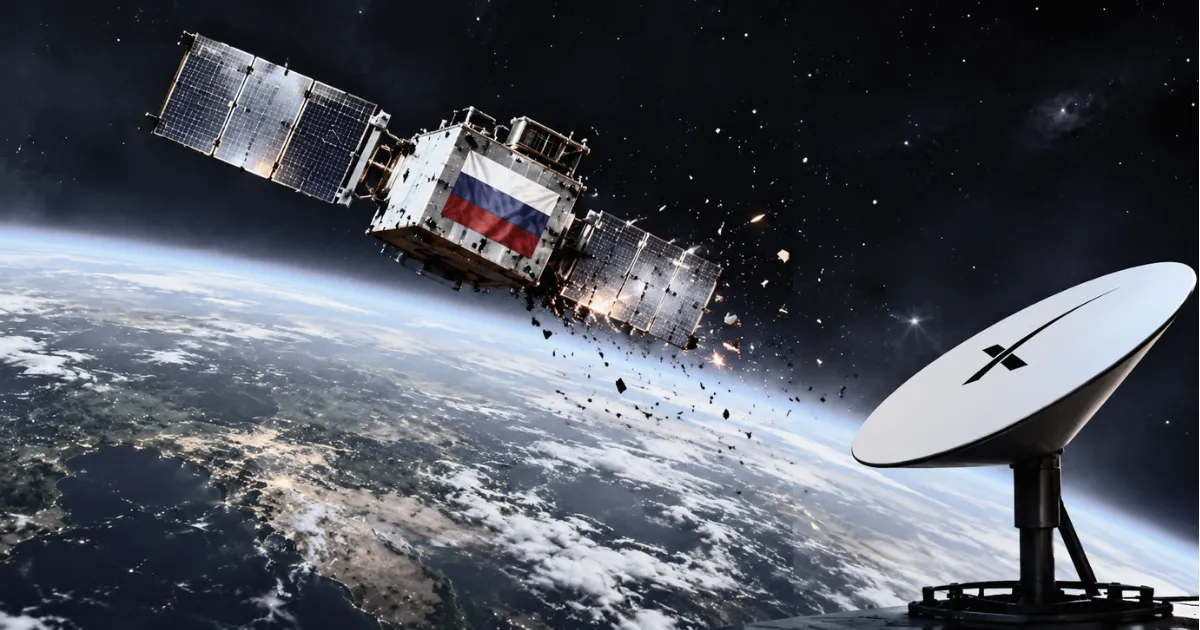
Getting a satellite into space is the famous part. The hard part is getting it to the right height and keeping it working for years. Russia’s answer to Starlink is finding that out the difficult way.
Key Takeaways
- Rassvet is Russia’s Starlink rival. Bureau 1440 is building it to give Russia its own satellite-internet network.
- Satellite No. 17 burned up on October 30, 2026. Rassvet-3 No. 17 re-entered the atmosphere after failing to raise its orbit, having spent just over three months in space.
- No. 23 had a narrow escape. It resumed manoeuvring and climbed to about 296 kilometres by October 29.
- It isn’t the first loss. No. 4 was lost in June, which points to concerns about the propulsion systems.
- The causes aren’t confirmed. Public tracking data doesn’t show every satellite failing the same way.
- The long-term goal is hundreds of satellites. Repeated setbacks could complicate the plan to reach it.
Why Russia wants its own network
Satellite internet matters more every year. It can reach remote communities, serve businesses where broadband doesn’t exist and keep communications running where ground infrastructure isn’t available. It also carries growing strategic and military value, which is why governments pay close attention to who controls it.
That’s the thinking behind Rassvet. Bureau 1440 is building it to give Moscow an independent communications system and reduce its reliance on foreign satellite networks. The aim is a constellation that can cover Russia’s vast territory and, eventually, reach beyond it.
The idea is easy to state and very hard to deliver. A network like this needs far more than rocket launches. Every satellite has to reach the right orbit, hold its position and keep working for years, and the whole fleet has to behave like one coordinated system. Rassvet is now discovering how much can go wrong before that happens.
What went wrong
On July 19, 2026, Russia launched 16 Rassvet-3 satellites on a Soyuz-2.1b rocket from the Plesetsk Cosmodrome. The satellites weren’t dropped straight into their final orbit. They were placed lower first, with the plan that their own engines would lift them gradually to their working altitude.
That climb is where things went wrong for some of them.
No. 17 never completed its orbit-raising manoeuvres. Without enough propulsion, it stayed in a low orbit where the very thin upper atmosphere still creates resistance. That resistance, called atmospheric drag, slowly bleeds away a satellite’s speed and height. The lower a satellite sits, the stronger the drag, and the harder it is to recover. On October 30 it re-entered the atmosphere and burned up, after just over three months in orbit. It was the second confirmed loss of a production Rassvet satellite, following No. 4 in June.
No. 23 came close to the same end. Its altitude had fallen to roughly 220 kilometres, which put it at real risk of re-entry. But in late October it started manoeuvring again and began to climb, reaching about 296 kilometres by October 29. That’s an encouraging recovery, though it’s still below where the network wants its satellites to operate.
One satellite lost and one rescued, from the same launch, is a telling contrast. It suggests that the problem isn’t a clean, uniform failure across the whole batch, and that the outcome can turn on whether the engines work when needed.
The propulsion question
The worry centres on the engines. Rassvet’s deployment plan relies on electric propulsion, including plasma thrusters, to move satellites up to their operational orbits. These engines work gently and over time rather than with a big burn, so a satellite depends on them starting up and running reliably for weeks. If they don’t activate or don’t perform as expected, the satellite can get stuck low, with drag working against it the whole time.
The losses of No. 17 and No. 4, along with delays and difficulties affecting other spacecraft, suggest a pattern worth taking seriously. A recurring problem in the same phase of flight usually points to something systematic, and propulsion is the obvious suspect.
But I’d be careful not to go further than the evidence allows. Public tracking information doesn’t establish that every satellite has suffered the same mechanical failure, and the precise cause of each problem hasn’t been independently confirmed. A run of orbital trouble is a legitimate warning sign. It isn’t proof that the entire programme is failing.
Why two satellites matter more than they sound
When a country plans hundreds of satellites, losing two can seem minor. If you only count spacecraft, it probably is. The real issue isn’t replacing individual units. It’s whether enough satellites are working, at the right altitude and in the right positions, at the same time.
A constellation only delivers service when it functions as a system. With too few operational satellites, coverage develops gaps, and anyone who needs a continuous connection will notice. That’s very different from a single satellite that happens to work or fail.
This is where Starlink holds such a large lead. It already has a very large number of satellites, regular launches and an established operation behind them. Russia is trying to build a comparable capability and has to solve several problems at once:
- reliable hardware once the satellite is in orbit,
- enough manufacturing capacity to build many spacecraft without cutting quality,
- a steady supply of successful launches,
- ground stations and user terminals so people can actually get a usable service, and
- a way to replace ageing or failed satellites over time.
A weak link in any one of these slows everything else. Fixing a propulsion problem doesn’t help much if production or launches can’t keep up, and a flawless satellite is no use without the ground infrastructure to serve customers.
The big ambition
Russia hasn’t backed away. Bureau 1440 is working towards a large constellation, with a long-term ambition of about 900 satellites by 2035. It has also been testing satellite-internet capabilities in remote Russian regions, where ordinary broadband is difficult and expensive to build. For a country of Russia’s size, that’s an obvious early use case.
There’s a strategic side as well. Satellite communications can support military logistics, communications and unmanned systems, and reports have described Rassvet-related equipment appearing in Russian military contexts. One of those reports relies on a claim from Ukraine’s defence intelligence, and how far the system is actually used is hard to establish independently. So treat that part with care.
What does seem clear is that, for Moscow, Rassvet is about more than giving people internet access. It’s about communications independence and national security. That raises the stakes for getting it right, and it explains why the programme is likely to keep going despite the setbacks.
Can Rassvet still compete?
It’s too early to write it off. Some Rassvet spacecraft have successfully raised their orbits, and monitoring has recorded progress among parts of the constellation. The failures don’t prove that Russia can’t build a working network.
What the programme still has to show is that it can repeat that success reliably across much bigger batches. That’s the real test, and it’s a tougher one than it sounds. A handful of well-behaved satellites proves the design can work. Hundreds of well-behaved satellites, launched on schedule, is what proves the system can scale.
My view is that Starlink’s advantage isn’t just the number of satellites in the sky. It’s the way production, launches, network management, ground infrastructure and a working customer service all fit together. Russia has to build every one of those pieces, while dealing with technical setbacks and the difficulty of expanding a complex space programme. A network of hundreds can’t depend on emergency recoveries and one-off successes. It needs the boring kind of reliability where launches simply work.
What I’d watch next
- Orbit-raising results from the same launch. Do the remaining satellites reach their working altitude, and how many?
- No. 23’s progress. Does it keep climbing, or stall again?
- Whether a technical cause emerges. A confirmed explanation would show if this is one fixable issue or several.
- Launch cadence. Hundreds of satellites need frequent, successful launches.
- Service milestones. Real users and ground infrastructure matter more than satellite counts.
The bottom line
The loss of No. 17, following No. 4, shows how risky it is to deploy a large constellation. The recovery of No. 23 is encouraging, but it doesn’t erase the broader concerns about orbit raising and propulsion reliability.
For Russia, the challenge is no longer just reaching space. It’s proving that satellites can get to the right orbit, stay operational and work together as a dependable network. Ambitious targets and successful rocket launches won’t be enough on their own. Reaching orbit is only the beginning, and staying there while delivering a dependable service is the real achievement.
Disclaimer: This article is for informational and educational purposes only. It discusses developments in the satellite communications and space technology sectors and should not be interpreted as investment, political or military advice.