
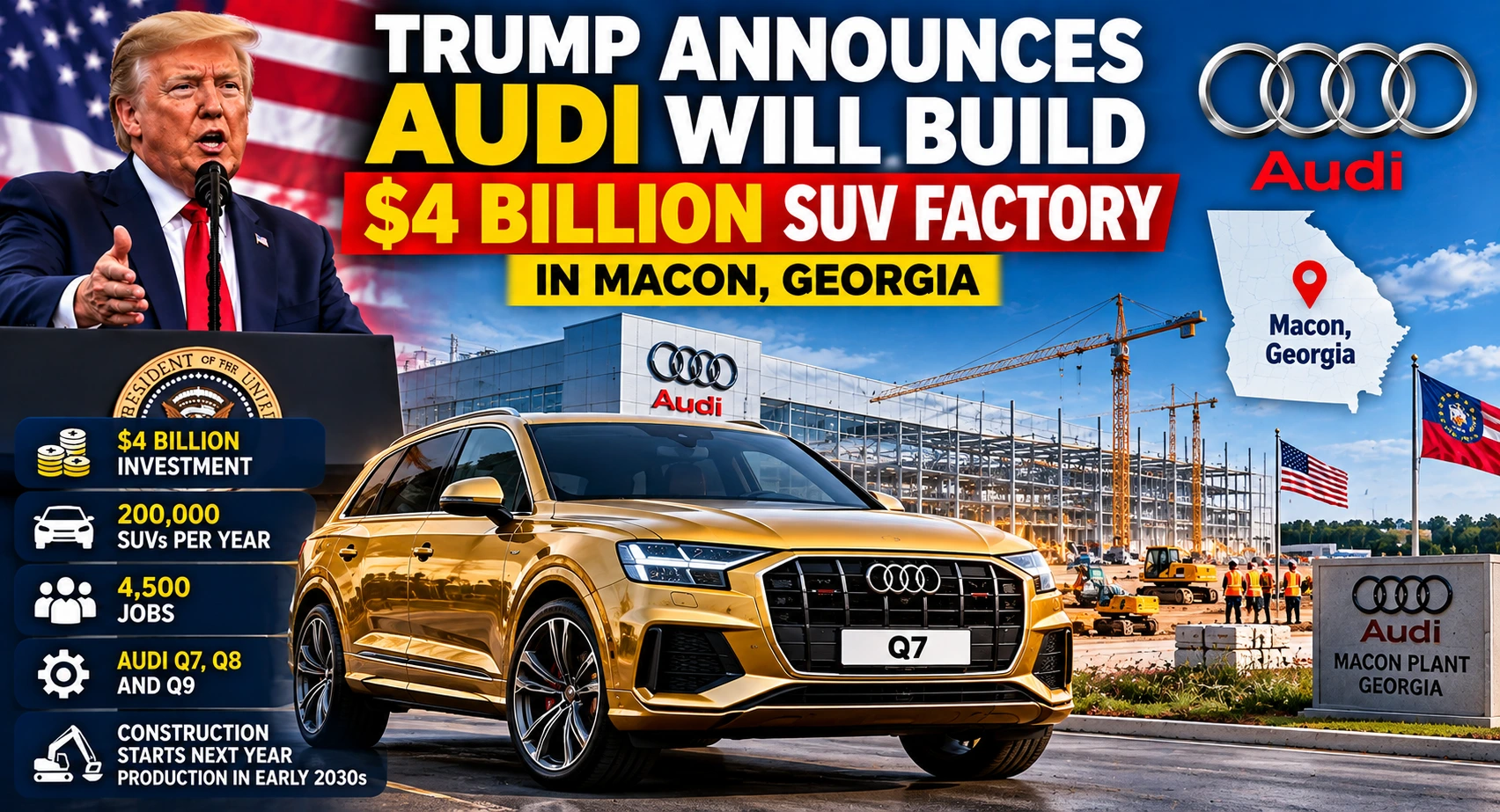
Volkswagen-owned Audi plans to build its first US manufacturing facility in Georgia, with capacity for 200,000 vehicles annually. The investment could reshape the luxury automaker’s American strategy as tariffs and global competition put pressure on the car industry.
Key Takeaways
- A major US investment: Audi plans to invest approximately $4 billion in a new manufacturing facility at the Middle Georgia Megasite in Georgia.
- Production capacity: The plant is designed to produce up to 200,000 vehicles annually, focusing on premium SUVs for North American customers.
- Jobs: Georgia officials estimate the project will create approximately 4,500 jobs.
- Timeline: Site grading is expected to begin in 2027, construction in 2028 and full production in 2031.
- Tariff exposure: Local manufacturing could reduce Audi’s dependence on imported vehicles and help manage trade-related costs over time.
- A long-term commitment: The plant is a significant investment, but its financial benefits will depend on execution, demand and future trade policies.
What Happened on October 24?
President Donald Trump announced Audi’s planned Georgia factory during a rally in Perry, near Macon, on October 24, 2026. The German luxury automaker, owned by Volkswagen Group, subsequently confirmed its plan to establish its first US production site in Georgia.
According to the Georgia governor’s office, the project involves approximately $4 billion in investment and is expected to create around 4,500 jobs.
The Associated Press reported a $4.2 billion figure, while Audi’s own announcement and Georgia’s official release use approximately $4 billion. The difference should be kept in mind when comparing coverage of the project.
The factory will be located at the Middle Georgia Megasite, a prepared industrial development site in Peach County, within the wider Middle Georgia region.
Audi says the facility will have an annual production capacity of up to 200,000 vehicles. The company intends to manufacture premium SUVs tailored to North American customers, although the final production mix may depend on future market demand.
Reuters has reported that the expected models include the Audi Q7, Q8 and Q9. Audi’s official announcement, however, describes the plan more broadly as production of premium SUVs
Why Is Audi Investing in America Now?
Audi already sells vehicles in the United States, but establishing a local manufacturing base represents a major change in its operating strategy.
Historically, Audi has relied on vehicles produced outside the United States to serve American customers. That exposes the company to international shipping costs, currency movements and changes in US trade policy.
1. Managing tariff costs
Tariffs are taxes imposed on imported goods. When a country raises tariffs on imported vehicles or components, automakers may face higher costs when selling products manufactured abroad.
Reuters reported that US tariffs cost Audi approximately €1.2 billion, or about $1.4 billion, in 2025.
Producing vehicles inside the United States could reduce Audi’s exposure to tariffs on imported finished vehicles. It could also bring production closer to customers and create a more locally integrated supply chain.
However, a domestic factory does not eliminate every trade-related cost. Imported components may still face tariffs, and the project will require years of investment before vehicles begin rolling off the production line.
2. Strengthening its position in the US luxury market
The United States is an important market for premium vehicles, where Audi competes with brands such as BMW and Mercedes-Benz.
Local production could help Audi respond more flexibly to American customer preferences, improve its supply arrangements and build a stronger long-term presence.
The investment also allows Audi to design a new facility around its future manufacturing requirements rather than simply adapting an existing plant.
Audi says its Georgia decision reflects factors including workforce availability, logistics, access to customers and proximity to automotive suppliers.
Source: Audi’s official announcement.
What Will the Factory Produce?
The facility is intended to manufacture premium SUVs for North American customers.
Reuters has reported that the expected models include:
- Audi Q7: A large luxury SUV.
- Audi Q8: A premium SUV with a sportier design.
- Audi Q9: An additional large, premium SUV expected to form part of Audi’s future lineup.
The final production plans and vehicle specifications may evolve before manufacturing begins.
The factory is designed for an annual capacity of up to 200,000 vehicles. That figure represents the facility’s planned capacity, not a guarantee that Audi will produce or sell 200,000 vehicles every year.
Actual output will depend on demand, production efficiency, supply-chain readiness and the company’s future product strategy.
Jobs and the Economic Impact on Georgia
The investment could have a substantial effect on Middle Georgia.
Governor Brian Kemp estimates that the project will create approximately 4,500 jobs. These positions could include manufacturing, engineering, maintenance, logistics, quality assurance and other operational roles.
The project may also create opportunities for local suppliers, construction companies, transportation providers and service businesses.
Georgia is preparing workforce-development programmes to help train employees for the facility. A new manufacturing operation of this scale can require specialised skills, particularly as vehicle production increasingly incorporates automation and advanced manufacturing technology.
However, the expected employment figure should be understood as a projection associated with the project, not as a count of jobs already created.
The economic benefits will depend on whether construction and hiring proceed as planned, how much of the supply chain is established locally, and how successfully the factory reaches its intended production capacity.
When Will the Factory Start Producing Cars?
The project will take several years to move from announcement to full production.
| Milestone | Expected timeline |
|---|---|
| Site grading and preparation | 2027 |
| Construction of the facility | 2028 |
| Full production | 2031 |
| Planned annual capacity | Up to 200,000 vehicles |
These milestones come from Georgia’s official project announcement.
This timeline has an important financial implication: Audi will not receive the full benefit of US-based production immediately.
Until the plant is operational, the company will continue relying on its existing manufacturing and distribution arrangements. Even after production begins, it may take time for the factory to reach its planned output.
Investors should therefore distinguish between the announcement of a capital investment and the future earnings benefits that the investment may eventually deliver.
Do Tariffs Explain the Entire Decision?
The announcement has become part of a wider debate about whether tariffs encourage companies to manufacture more goods in the United States.
President Trump has presented the investment as evidence that his trade policies can encourage domestic manufacturing. Some political supporters have also credited tariffs and regulatory changes for attracting the project.
Audi, meanwhile, describes the investment as part of its long-term strategy to strengthen its American business, improve competitiveness and establish a more balanced global production network.
Both the policy environment and the company’s broader commercial strategy are relevant to understanding the decision. But the announcement alone cannot establish how much of the investment was caused by tariffs rather than other factors, including market access, logistics, workforce availability and long-term growth ambitions.
Tariffs can make imported vehicles more expensive, creating an incentive for local production. They can also increase the cost of imported components and introduce uncertainty for businesses planning large investments.
The factory’s long-term financial performance will depend on the combined effect of these factors, not on tariff policy alone.
What About the South Carolina Vehicle Project?
Reports have also referred to plans involving approximately 25,000 vehicles annually in South Carolina.
This is a separate project associated with Scout Motors, Volkswagen Group’s off-road vehicle brand. Scout’s factory is under construction in Blythewood, South Carolina, and is not the same facility as Audi’s planned Georgia plant.
Keeping these projects separate is important when evaluating Volkswagen Group’s overall US manufacturing commitments.
Together, the investments indicate a broader effort to expand production capacity in the American market, but their costs, timelines, products and commercial objectives differ.
What Does This Mean for Investors?
Audi’s factory announcement is significant, but an investment of this size should be assessed over the long term.
Potential opportunities
- Reduced exposure to imported finished vehicles: Local production may help manage some tariff-related costs.
- A stronger US presence: Manufacturing closer to customers may improve responsiveness to market demand.
- Potential scale benefits: Higher production volumes can improve efficiency if the plant operates effectively and demand supports its capacity.
- Regional supplier development: A local manufacturing base may create a more integrated supply chain.
Risks to monitor
- High upfront investment: The factory requires substantial capital before it begins generating vehicles.
- Execution risk: Construction delays, hiring challenges or production problems could increase costs.
- Demand uncertainty: Planned capacity does not guarantee that customers will buy the vehicles produced.
- Trade-policy changes: Future tariffs and trade agreements could alter the economics of local manufacturing.
- Competitive pressure: Audi must continue competing with established luxury brands and changing customer preferences.
For Volkswagen Group investors, the relevant question is not simply how much money Audi plans to spend. It is whether the factory can strengthen the company’s competitive position and generate sufficient long-term returns.
The announcement is an important strategic signal, but the investment’s ultimate financial impact will become clearer as construction progresses and production plans develop.
The Bottom Line
Audi’s planned Georgia factory represents a major step in its US manufacturing strategy. With approximately $4 billion in planned investment, capacity for up to 200,000 vehicles annually and an estimated 4,500 jobs, the project could become an important part of the company’s long-term American operations.
The investment may help Audi manage some tariff exposure, bring production closer to customers and strengthen its competitive position in the luxury SUV market.
But the announcement is only the beginning. Construction is expected to start in 2028, with full production planned for 2031. Until then, costs, trade policy, market demand and execution will shape the project’s prospects.
The real test will be whether Audi can turn this large manufacturing commitment into a competitive and profitable US business.
Frequently Asked Questions
1. Did Trump announce an Audi factory in Georgia?
Yes. President Donald Trump announced the planned Audi factory at a rally in Perry, Georgia, on October 24, 2026. Audi and Georgia state officials subsequently confirmed the investment.
2. Where exactly will the Audi factory be built?
The factory is planned for the Middle Georgia Megasite in Peach County, near Macon, Georgia. Although the site is commonly described as being near Macon, the facility itself will be located in Peach County.
3. How much will the Audi factory cost?
Audi and the Georgia governor’s office announced an investment of approximately $4 billion. The Associated Press reported a figure of $4.2 billion, but the official company and state announcements cite approximately $4 billion
4. When will production begin at the Audi factory?
Audi plans to begin site grading in 2027, start construction in 2028, and begin full production in 2031. The facility is designed to produce up to 200,000 vehicles annually.
5. How many jobs will the Audi factory create?
According to Audi and Georgia Governor Brian Kemp’s office, the project is expected to create approximately 4,500 jobs in Middle Georgia. The investment may also generate additional opportunities for local suppliers, service providers, and workforce-training partners.
6. What vehicles will the Georgia factory produce?
Audi says the factory will manufacture premium SUVs tailored to North American customers. Reuters has reported that the models could include the Audi Q7, Q8, and Q9, although Audi’s official announcement has not confirmed the specific models.
Disclaimer: This article is for informational and educational purposes only and does not constitute investment advice. Project timelines, employment estimates and planned production capacity may change. Readers should consult official company announcements and financial filings before making investment decisions.